
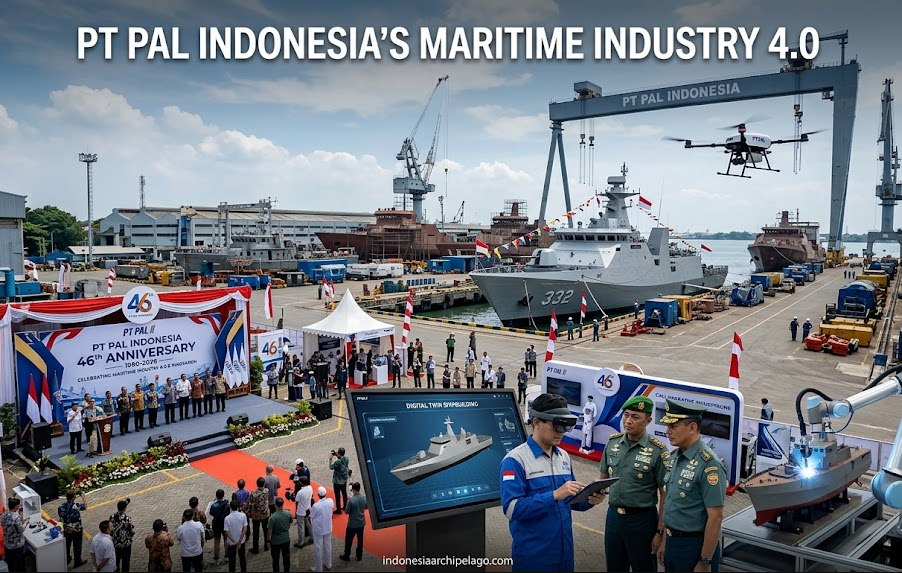
When PT PAL Indonesia marked its 46th anniversary in 2026 under the banner of Maritime Glory Day, the celebration carried weight beyond ceremonial speeches and ribbon-cutting moments. Five years after committing to a sweeping digitalization program across its Surabaya shipyard.
The state-owned defense manufacturer delivered something more persuasive than any progress report: four large vessels simultaneously in various stages of production, with two of them carrying enough strategic and diplomatic significance to redefine Indonesia's position in global naval manufacturing.
Maritime Industry 4.0 had moved from policy ambition to measurable industrial output.
When Digitalization Meets the Shipyard Floor
Industrial digitalization in heavy manufacturing environments rarely produces overnight results. Shipbuilding, with its complex multi-stage fabrication cycles, interdependent supplier networks, and precision engineering requirements, represents one of the more demanding environments in which to implement systems integration at scale.
PT PAL began that process in 2021, embedding digital workflow management, automated design coordination, and supply chain monitoring systems across its production ecosystem.
By 2026, the results had crystallized into something concrete. Dock time, the critical metric measuring how long a vessel actually spends under active construction on the shipyard floor, had been compressed significantly. Production scheduling had tightened.
Component procurement, historically a friction point in Indonesian defense manufacturing due to import dependencies and logistics lag, had been streamlined through integration with both domestic suppliers and international partners.
What the shipyard could now execute in a compressed timeline would previously have required considerably longer, and the gap was widening with each completed contract.
Four Vessels, One Landmark Year
Launching four large-scale vessels within a single calendar year is not a routine milestone for any shipyard operating in Southeast Asia. For PT PAL Indonesia in 2026, it was the direct product of compounding efficiency gains across every layer of its production system. Two of those four vessels carry particular significance, both for what they represent to Indonesia's naval modernization program and for what they signal to international clients watching from the region.
Among the most anticipated is the continued development of the Merah Putih Frigate program, specifically the Balaputradewa-class vessel stretching 140 meters and displacing 6,626 tons. Running alongside it in the production queue is the Landing Dock Philippines Number One, a 124-meter export vessel bound for the Philippine Navy. Each contract tells a different story about PT PAL Indonesia's expanding role in the Indo-Pacific defense supply chain, and together they form the most visible proof point yet for what Maritime Industry 4.0 has made possible at an operational level.
The Frigate That Defines an Era
Indonesia's Merah Putih Frigate program has been building momentum since its initial framework agreement, but the Balaputradewa-class vessel now in production represents its most mature and capable iteration. Built on the Arrowhead 140 platform, a design developed through collaboration with international naval architects, the frigate is engineered as a multidomain warship capable of operating simultaneously against aerial, surface, and submarine threats.
At the core of its combat architecture sits a 64-cell vertical launch system, providing flexibility across missile configurations depending on mission requirements. Sensor and navigation capability is drawn from AESA radar technology supplied by Aselsan, the Turkish defense electronics company whose systems are deployed across multiple NATO and partner-nation navies.
Combining a domestically assembled hull with internationally certified weapons integration and sensor packages, the frigate represents exactly the kind of hybrid capability model that Indonesia's defense procurement planners have been working toward for over a decade.
Early 2026 brought further confirmation of the program's long-term trajectory. Indonesia expanded its letter of intent commitment to include licensing rights for a third and fourth unit of the Merah Putih Frigate class.
Signaling that the program has cleared its critical evaluation phase and is being treated as a cornerstone of the country's naval force structure for the foreseeable future.
Six Months That Changed the Export Benchmark
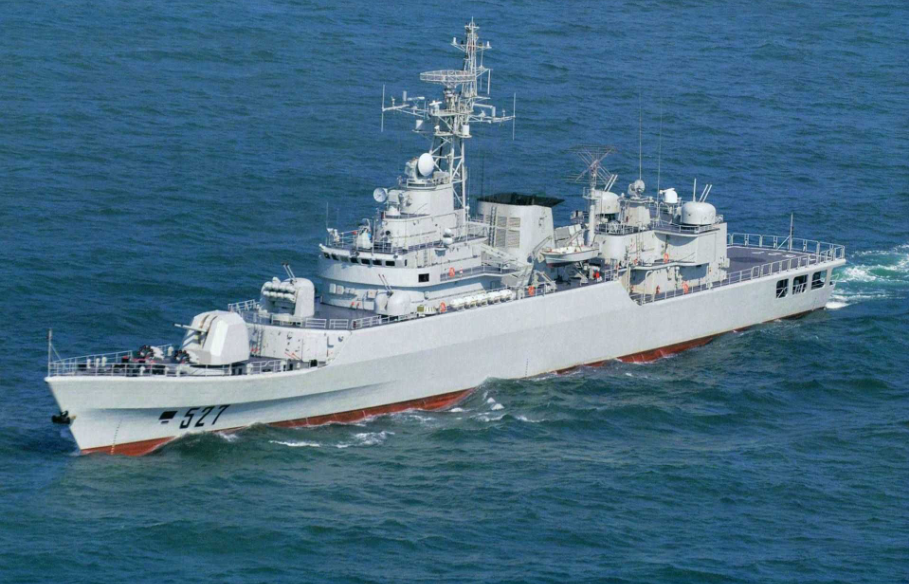
Among the four vessels in PT PAL Indonesia's 2026 production slate, the Landing Dock Philippines Number One carries a particular significance for how Indonesia's shipbuilding reputation is perceived abroad. Philippine Navy vessels BRP Tarlac and BRP Davao del Sur, both produced by PT PAL under earlier export contracts, established the initial baseline for what Indonesian shipbuilding could deliver to a foreign client at large-scale dimensions.
Landing Dock Philippines Number One has redrawn that baseline. Dock time for its construction came in at six months, a record for vessels of this class produced at the Surabaya facility, and a measurable improvement over the timelines that defined its predecessors.
For a foreign client operating under procurement schedules with fiscal year constraints and fleet deployment commitments, that kind of compression in delivery timeline is not a minor administrative convenience, it is a procurement differentiator.
Philippine defense officials overseeing the contract will have observed a shipyard performing at a pace that compares favorably with regional competitors operating with larger facilities and longer establishment histories.
Supply Chain Integration Beyond the Shipyard Gate
Maritime Industry 4.0 at PT PAL was never designed as an internal optimization exercise alone. From its earliest planning stages, the program was structured to extend efficiency gains outward through the broader national industrial ecosystem.
Thousands of domestic suppliers, ranging from component manufacturers producing structural steel and pipe fittings to electronics fabricators and precision machining shops, have been drawn into the integrated supply chain network that now feeds PT PAL's production lines.
Private shipyards operating as subcontract partners have similarly been brought into the coordination framework, creating a distributed production model in which work packages can be allocated, tracked, and quality-verified across multiple facilities in real time.
Small and medium enterprises in the maritime sector, historically operating at the margins of large defense contracts due to documentation barriers and procurement complexity, have gained structured access to supply chain participation through the same digital integration platforms.
Taken together, these linkages represent a multiplication of economic activity that extends far beyond PT PAL Indonesia's own balance sheet. Every frigate frame assembled in Surabaya carries within it the labor output of suppliers across East Java and beyond.
Every export landing dock delivered to Manila contains procurement value that has moved through Indonesian industrial hands before reaching the shipyard floor.
Indonesia's Growing Weight in Regional Naval Trade
Southeast Asia's naval procurement environment has shifted considerably over the past decade. Rising maritime territorial tensions, expanding coast guard and blue-water navy modernization programs, and growing defense budgets across the Philippines, Vietnam, Malaysia, and Thailand have collectively created demand for capable regional suppliers who can offer faster delivery timelines and more flexible financing arrangements than traditional Western defense exporters.
PT PAL Indonesia has positioned itself to capture a meaningful portion of that demand. Its track record with the Philippine Navy now spans multiple landing dock deliveries, establishing a reference client relationship that carries weight in conversations with other regional navies evaluating Indonesian shipbuilding capacity.
Arrowhead 140 frigate production, paired with AESA sensor integration and vertical launch capability, demonstrates that PT PAL can operate at the high end of the naval capability spectrum, not only in patrol vessel or auxiliary ship categories.
Maritime Industry 4.0 underpins all of it. Without compressed dock times, without supplier integration, without digital design coordination reducing rework and material waste.
The competitive pricing and delivery commitments that make PT PAL attractive to foreign buyers would not be sustainable at this scale.

What the 46th Anniversary Actually Measured
Anniversaries in Indonesia's state enterprise calendar often carry more symbolic than substantive weight. Maritime Glory Day 2026 departed from that pattern in meaningful ways.
By anchoring its celebration to the simultaneous launch of four large vessels and the public disclosure of performance benchmarks including the six-month dock time record for the Philippine landing dock, PT PAL converted what might have been a ceremonial occasion into an auditable demonstration of industrial capability.
Observers within Indonesia's defense and industrial planning community will have noted the contrast with where PT PAL stood in 2021 when Maritime Industry 4.0 was still a roadmap rather than a production system.
Framing 2026 as a milestone year was not marketing language. Four vessels, export records, expanded frigate commitments, and a supply chain that now integrates thousands of national enterprises represent a transformation with documented, verifiable outputs.
Engineering Talent as the Program's Core Asset
Behind every digitalized workflow and compressed production timeline is an engineering workforce that had to develop alongside the systems it was being asked to use. PT PAL's investment in Maritime Industry 4.0 carried implicit requirements for workforce capability upgrades that went beyond software licensing and equipment procurement.
Naval architects, production engineers, welding specialists, and systems integrators at the Surabaya facility have all had to adapt to working within digital coordination environments that did not exist in their earlier careers.
Training programs, both formal and on-the-job, have built institutional knowledge at a level of depth that cannot be easily replicated through equipment purchase alone.
When the program eventually moves toward training partner-nation personnel or supporting technology transfer agreements with foreign buyers, that accumulated workforce knowledge becomes a transferable asset in its own right.
Projecting Forward From Maritime Glory Day
PT PAL's 2026 production achievements set a new baseline from which the next phase of Maritime Industry 4.0 must be measured. Maintaining the efficiency gains already recorded will require continued investment in systems maintenance, supplier development, and workforce training.
Scaling those gains further will depend on whether the program's digital infrastructure can absorb larger contract volumes without reverting to the scheduling bottlenecks that characterized earlier production cycles.
On the horizon, several variables will test that capacity. Merah Putih Frigate units three and four, now covered by expanded LOI commitments, will enter planning phases that stress-test the supply chain integration model at volumes beyond what the current program has yet processed.
Regional interest in Indonesian-built vessels, if converted into new export contracts, will add further load to a production system that has demonstrated it can handle concurrent large-scale builds but has not yet done so at maximum theoretical throughput.
A Shipyard That Has Earned Its Moment
Five years after Maritime Industry 4.0 began reshaping how PT PAL Indonesia approaches naval production, Maritime Glory Day 2026 offered a moment of public reckoning with what that transformation has produced. Four large vessels in concurrent production. A six-month dock time record for export landing docks.
Expanded frigate commitments covering a third and fourth hull. Thousands of national enterprises woven into an integrated supply chain feeding one of Southeast Asia's most capable defense shipyards.
None of it arrived without sustained institutional effort, capital commitment, and willingness to absorb the friction that comes with any large-scale industrial change program.
PT PAL has earned the right to mark 2026 as a milestone year, not because it held a celebration, but because the production floor delivered the evidence that justified one.