
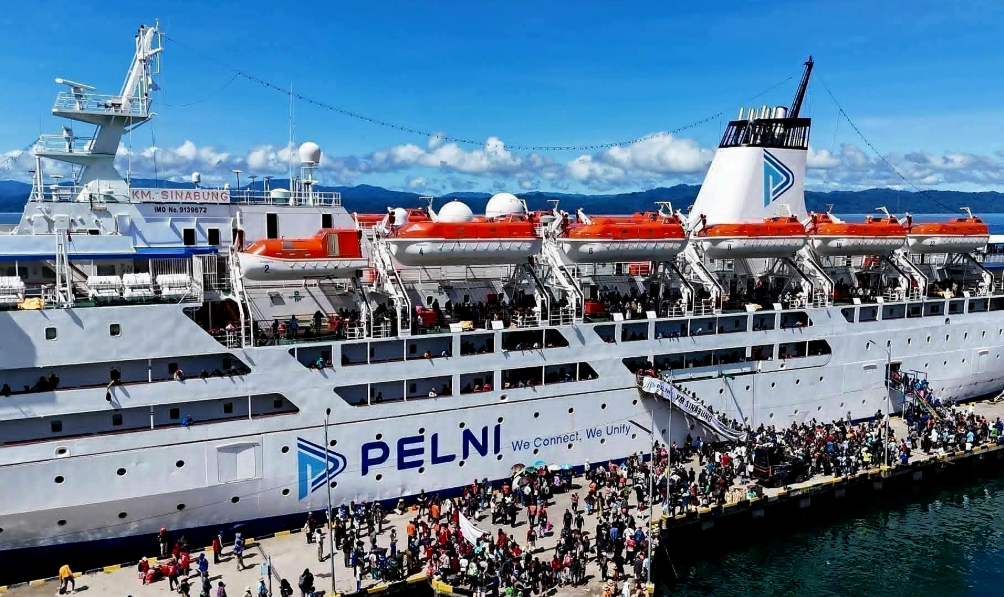
For most Indonesians living outside Java, a PELNI ship is not merely a mode of transport. It is the thread that connects a family in Sorong to relatives in Surabaya, the vessel that carries goods to markets in remote Maluku, the route that gives meaning to the phrase "one archipelago." For PELNI at 74th years, PT Pelayaran Nasional Indonesia has carried that responsibility across more than 17,000 islands. What is changing now is not the mission, it is the machine behind it.
Marking its 74th anniversary on April 28, 2026, PELNI unveiled a comprehensive account of the transformation it has undergone over the past four years under President Director Tri Andayani. The changes span visual identity, fleet rejuvenation, operational infrastructure, safety systems, and digital communications.
Taken together, they represent the most substantial overhaul the state-owned shipping company has undertaken in decades, and the implications reach well beyond the company's own balance sheet.
A Fleet Aging Toward Its Limits, and What the Government Did About It
The most pressing challenge PELNI has faced going into the 2020s is straightforward: its ships are old. Several vessels in the current fleet were built in the 1980s in Germany, and while they have been maintained through the years, the operational and safety risks associated with aging hulls are not indefinitely manageable.
KM Umsini, built in 1985, recently underwent repairs in Surabaya following a fire incident in Makassar and is expected to return to service in the second quarter of 2026. KM Lawit, constructed in 1987, and KM Tidar, from 1986, are both among the vessels slated for replacement.
The question of how to fund that replacement has been answered, at least in part, by the Indonesian government through State Capital Injection, known locally as Penyertaan Modal Negara (PMN). PELNI received PMN support in both 2024 and 2025, with the funds earmarked specifically for fleet acceleration and service quality improvements.
The DPR (House of Representatives) has consistently backed this support, and PELNI has committed to continuing the application process annually through 2029 until the older vessels are fully replaced.
Three new passenger ships, procured under Government Regulation Number 20 of 2010 on Water Transportation, are expected to arrive in early 2028. Tri Andayani, speaking at the anniversary event, described the government's support as institutional trust translated into action.
The PMN commitment signals that the state views PELNI's role in national maritime connectivity as essential infrastructure rather than a commercial venture that must stand purely on its own returns.
PELNI at 74th, The Scale of a Network That Cannot Simply Stop
Before understanding what the transformation means, it helps to understand what PELNI actually operates. As of its 74th anniversary, the company runs 25 passenger ships serving 483 route segments across 75 ports. Beyond the main passenger network, PELNI maintains 30 pioneer routes serving remote and underserved regions classified as 3T areas — isolated, frontier, or underdeveloped. These pioneer routes reach 229 ports across 516 segments and 2,515 individual routes.
The company also operates 17 rede vessels for inter-ship and port-to-shore transfers, 8 sea toll freight routes under the government's national logistics connectivity program, and a dedicated livestock shipping route a service that reflects the specific agricultural realities of eastern Indonesia, where moving cattle between islands is a practical economic necessity with few land-based alternatives.
This network does not run on convenience. It runs on obligation. The communities at the end of these routes depend on PELNI in ways that make service degradation a welfare issue, not merely a commercial inconvenience.
Transforming the company while keeping this network operational is the context in which every upgrade must be understood.
The Operations Room and the Logic of Real-Time Visibility
One of the less publicized but operationally significant upgrades in PELNI's transformation is the establishment of an integrated Operations Room at its headquarters. The facility enables centralized, data-driven control of fleet movements, a shift from reactive coordination to proactive management.
When a ship encounters a technical issue at sea, or when a route requires adjustment due to weather or port congestion, the Operations Room provides the command structure to respond in real time rather than through fragmented communication chains.
For a company operating across 75 ports and 30 pioneer routes reaching the furthest corners of the Indonesian archipelago, this kind of integrated visibility is not a luxury.
It is the operational foundation that makes everything else — scheduling reliability, safety response, logistics coordination function at an acceptable standard.

Satellite Technology Closing the Distance
The operational upgrades in the physical command structure are matched by a significant leap in shipboard communications. In January 2026, PELNI officially launched the implementation of a new Ship Communication System (SisKomKap) across its entire passenger fleet, built on Low Earth Orbit (LEO) satellite technology through a partnership with BuanterOne, a telecommunications provider under PT Dwi Tunggal Putra, for the 2026 to 2029 period.
The technical shift is meaningful. PELNI's previous system relied on Geostationary Earth Orbit (GEO) satellites positioned roughly 35,786 kilometers above Earth, which produced latency between 550 and 1,500 milliseconds too slow for reliable real-time coordination.
The new LEO satellite network operates at altitudes between 500 and 1,200 kilometers, reducing latency to just 70 to 100 milliseconds, comparable to fiber optic connections on land.
For ships operating in the remote waters of eastern Indonesia, where terrestrial communications infrastructure is sparse, this is not an incremental improvement, it is a categorical one.
The new system covers internet connectivity, Vessel Monitoring System (VMS), Automatic Identification System (AIS), real-time schedule tracking, satellite phone and VoIP communications, onboard Wi-Fi for passengers, and remote device management.
Finance and Risk Management Director Anik Hidayati described the upgrade as central to Good Corporate Governance and directly tied to navigation safety and passenger service quality.
Safety Standards That Meet International Benchmarks
Alongside communications and operations, PELNI has upgraded its onboard safety infrastructure with the procurement of Marine Evacuation Systems (MES) , a modern emergency evacuation technology that meets international maritime standards.
The MES deployment addresses one of the longstanding concerns about aging vessels and legacy safety equipment, replacing older protocols with systems designed to current international requirements.
For passengers on long-haul routes between eastern and western Indonesia, some of whom travel for two to three days at sea, the presence of compliant and modern safety equipment is not an abstract policy achievement.
It is the difference between a journey that is merely affordable and one that is genuinely secure. That distinction matters most precisely to the passengers on pioneer routes, the ones with the fewest alternatives and the greatest exposure to risk.
A New Identity for a Company in Motion
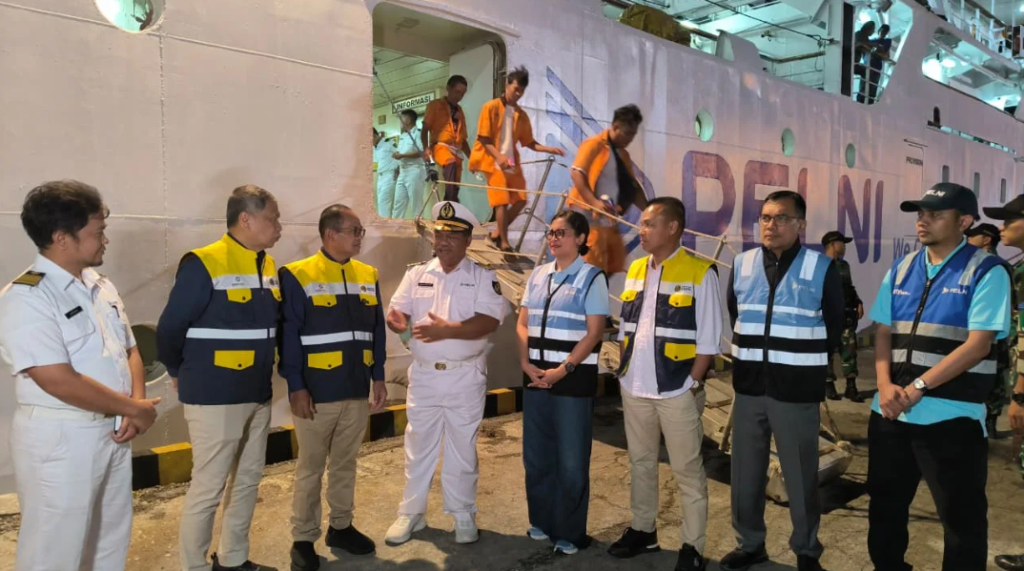
The transformation PELNI has documented over the past four years also includes a rebrand of its visual identity, including a new logo introduced in 2023 carrying the tagline "We Connect, We Unify." The rebranding extended to the visual presentation of the passenger vessels themselves, with refreshed designs intended to signal the shift toward a more modern, passenger-oriented service culture.
The visual refresh, taken alone, would prove little. But as part of a package that includes new ships on order, LEO satellite connectivity rolled out across the fleet, a data-integrated Operations Room, and international-standard safety equipment, it functions as the outward expression of inward change rather than a substitute for it.
PELNI has also achieved the Informatif rating under Indonesia's Public Information Disclosure framework, a governance benchmark that reflects accountability toward the public it serves.
What This Means for the Archipelago
The significance of PELNI's transformation extends well beyond the company's own metrics. Indonesia's geographic reality, an archipelago of more than 17,000 islands spread across nearly 2 million square kilometers of ocean, means that sea transportation is not a legacy system waiting to be replaced by aviation and roads.
It is a permanent structural necessity, particularly for the communities that pioneer routes and sea toll corridors are specifically designed to serve. A PELNI that operates with real-time fleet visibility, LEO-grade communications, newer vessels on the way, and modern safety systems is not just a better company.
It is a stronger piece of the national infrastructure that connects eastern Indonesia to the economic opportunities concentrated in the west, that enables agricultural trade including livestock movement to function across island boundaries, and that gives the communities most dependent on sea transport a service worthy of the role it plays in their lives.
At 74, PELNI is not starting over. It is upgrading the engine while the ship is still at sea and the scope of what has changed in four years suggests the transformation has the structural depth to last well beyond the anniversary that prompted its telling.