

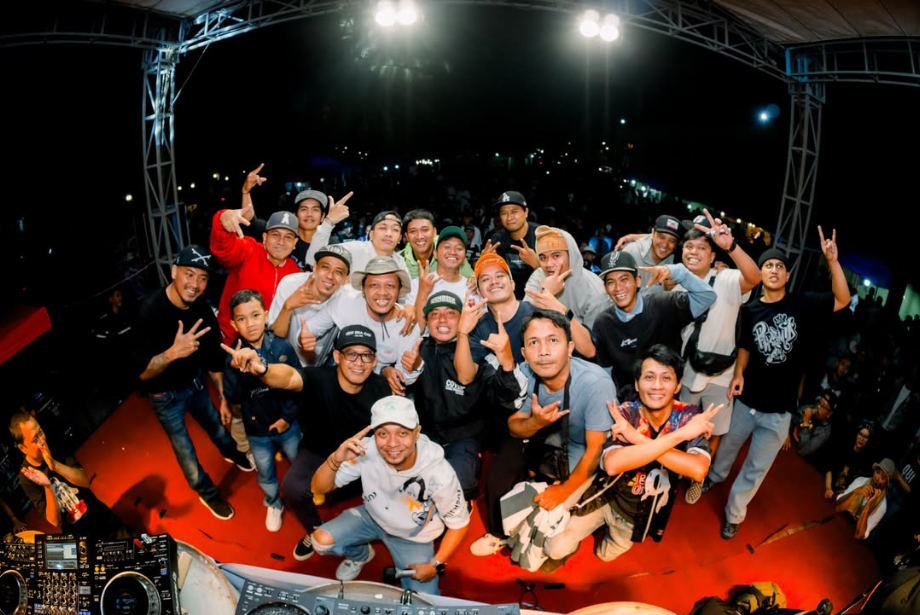
Malang Kembali Hip-Hop stands as a cultural statement that requires no extended justification. After more than a decade without a major event that unified all four elements of hip-hop culture under a single roof, Malang City returned to prove that this subculture never actually died — it was accumulating pressure, waiting for the right moment to detonate. That moment arrived at Lapangan Museum Brawijaya on Friday, 24 April 2026, under the banner of "satu kota, satu frekuensi" — one city, one frequency.
The last time Malang Kembali Hip-Hop was held was in 2012. The gap of more than thirteen years was not a void. It was a compression of energy across a community that continued moving in its own channels — through underground sessions, studio recordings, street jams, and walls — without the infrastructure of a unifying stage.
That infrastructure is now back, and with it, the clearest signal that Malang City's hip-hop identity is not a relic.
The Event Vision: One Frequency Beyond the Stage
The vision behind Malang Kembali Hip-Hop extends beyond a single night of performance. From its foundation, the event was structured as a collective declaration — that hip-hop in Malang City is not a heritage artifact requiring preservation, but a living force operating continuously within communities, studios, dance floors, and public walls.
The choice of Museum Brawijaya as the venue was not incidental. A historically loaded space provides the right symbolic weight for a cultural reunification of this scale.
The ambition of the event reaches past local reunion. Its largest declared hope is to reignite hip-hop communities across all regions of Indonesia, using Malang City as the reference point that re-establishes its position as one of the most credible hip-hop centers in the country.
That claim is not made through nostalgia. It is backed by the lineups, the legends on the bill, and the euphoria of a community that has been waiting for this moment with full awareness of what it means.
Malang City and a Hip-Hop Community That Never Stopped
Malang City has long been recognized for sustaining subcultures that do not require mainstream validation to survive. Since the late 1990s, the city's hip-hop scene grew organically through small events in urban pockets, freestyle sessions in public parks, home studio recordings, and walls that became portfolios for graffiti writers.
That depth of community production is what separates Malang from cities that merely follow national trends — the identity here was built from the ground up and maintained independently.
The hip-hop community in Malang City does not operate as a single unified body. It exists as clusters of subcultures, each carrying its own ecosystem, figures, and internal history — from rap crews active in battle circuits, to bboys running regular jam sessions, graffiti writers treating the city's surfaces as ongoing exhibitions, DJs anchoring the party infrastructure, and beatboxers building a technically demanding discipline with its own competitive circuit.
The 4 Elements and the Rise of Beatbox in Malang City
Hip-hop was built on four foundational pillars: rapping or MCing, DJing, breakdancing or bboying, and graffiti writing. These are not independent art disciplines that happen to share a name — they are an interconnected system of expression that collectively form what is understood as hip-hop culture.

In Malang Kembali Hip-Hop, all four elements are present with equal weight, refusing the hierarchy that places rap at the singular center of attention while sidelining everything else.
Beatbox, historically framed as the fifth element within hip-hop's developmental canon, holds a significant position in this event through the participation of Malang Beatbox as a performing community. In Malang's scene, beatbox is not decorative.
It has grown into a discipline with high technical standards, its own competitive events, and figures who carry recognition well beyond the city's boundaries. Its inclusion in Malang Kembali Hip-Hop reflects how the event treats the culture as a complete system rather than a music showcase with supporting acts.
Den Djuko: The Legendary Voice of Rap Malang City
In the documented history of rap in Malang City, Den Djuko occupies a position that cannot be bypassed. He is not simply a rapper who was active during a particular era — he represents a foundational layer of proof that Indonesian-language lyricism can carry weight, originality, and identity without borrowing legitimacy from external references.
His work circulating through the underground scene left an imprint that younger generations in Malang's rap community still trace their lineage back to.
His presence in Malang Kembali Hip-Hop is not ceremonial. Den Djuko on the bill functions as a signal to the community that the event acknowledges where the scene came from, not just where it is going.
Oldschool actors standing on the same stage as current performers is one of the structural choices that gives this event a different gravity from standard hip-hop concerts. It turns the lineup into a timeline.

DJ Yani: The Legendary DJ Who Shaped the Turntable Scene
Behind every functional hip-hop event is a DJ infrastructure that determines whether the energy holds or collapses. In Malang City, DJ Yani is the figure whose name is attached to the era when DJing in this city developed a technical identity distinct from simply playing records at parties.
The turntable scene in Malang City grew its credibility in part through figures like Yani, who treated the craft with the same seriousness that practitioners in Jakarta or Bandung were applying to it.
For younger DJs now active in Malang, DJ Yani represents a reference point — the standard against which local turntable skill has long been measured. His return as part of Malang Kembali Hip-Hop closes a generational gap on stage and demonstrates that the city's DJ lineage is continuous, not severed.
Sunny: The Bboy Legend Who Put Malang Breakdancing on the Map
Breakdancing in Malang City carries a competitive history that extends far beyond local jam sessions. Sunny, recognized as a legendary figure in Malang's bboying community, is one of the names that placed the city's breaking scene in conversations beyond East Java.
Bboying demands a physical commitment and a technical vocabulary that takes years to build, and Malang Breakin — the crew performing at this event — continues the tradition that figures like Sunny established through sustained practice and competition.
The presence of Malang Breakin on the Malang Kembali Hip-Hop lineup connects the current generation of breakers to that older lineage. For an audience that may only associate the city with its rap output, watching bboys perform at full competitive level inside the event framework reframes what Malang hip-hop actually contains.
NGACO FAMS: The Graffiti Legend Who Marked the City
Graffiti in hip-hop is not vandalism with a cultural label attached to it. It is a visual discipline with its own history of letters, styles, techniques, and writers who built reputations through the consistency and quality of their work on public surfaces.
In Malang City, NGACO Fams is the name associated with the period when local graffiti writing developed its own aesthetic language rather than simply reproducing styles imported from larger cities.
NGACO Fams mean “NGalam Aerosol COmmunity”, as a crew within it represent the visual identity layer of Malang's hip-hop culture. Their work on city walls functioned as public documentation of the scene's existence — evidence that the culture was present in physical space, not just audible at events.
The graffiti element within Malang Kembali Hip-Hop carries this visual dimension into the event, making the aesthetic of the culture as visible as its sound.

Ragil: The Legendary Beatboxer Representing the Fifth Element
Ragil stands as the primary legendary figure in Malang City's beatbox scene — the name most directly associated with establishing beatbox as a credible discipline within the local hip-hop community rather than a novelty act between sets.
Building a beatbox scene requires more than personal skill. It requires convincing a community that the discipline deserves its own space, its own standard, and its own figures. Ragil carried that work in Malang City.
His recognition as a legendary beatboxer in this event positions Malang Beatbox — the community performing at Malang Kembali Hip-Hop — as an institution with a documented origin, not simply a group of enthusiasts who showed up recently.

The Guest Star Lineup: A Full Spectrum of Malang Hip-Hop
The performing lineup for Malang Kembali Hip-Hop reads as a structural cross-section of what Malang City's hip-hop scene actually contains. Nganchuk Crew x King Abdi leads the bill — a pairing that places one of Malang's established rap collectives alongside a name that carries weight across the national hip-hop audience.
Alongside them, B.E.N.D.O.T., TRAC, NWM, Noise Brain, GACO, Virga, and Pantera Negra fill the rap and performance spectrum with range that covers different aesthetics and eras within the scene.
Malang Breakin and Malang Beatbox anchor the non-rap elements on stage, while the DJ presence comes through DJ Dhemitz and DJ Only Dee — names active in the city's current party and event circuit. MC duties fall to Tonny Gentong and Sunny Toepad, whose roles keep the event's energy structured and its crowd connected to the program.
Dog Da Town, Genetics, Pijar, Bonerutzy, Wiz, D-Use, Nokace, Marga O, Sync K, Carbonez, Posser Killah, Eastside Connection, and Real Young Gunz complete a lineup that demonstrates how deep the bench of Malang hip-hop talent actually runs. Den Djuko's inclusion as a performing legend places the historical layer directly on stage rather than in a commemorative slideshow.

A Reunion for Oldschool Actors: History Steps Back Onstage
One of the structural choices that separates Malang Kembali Hip-Hop from a standard festival format is its deliberate inclusion of oldschool actors as performers rather than honored guests seated in the audience. When legends from the 2000s and early 2010s scene return to the same stage that shaped them — this time alongside the generation they influenced — the event becomes a live archive rather than a concert.
This reunion dimension carries information that a purely contemporary lineup cannot transmit. It shows younger members of the community what the scene looked like before streaming platforms, before social media distribution, and before the infrastructure that current artists take for granted. It also demonstrates that those who built the foundation are still present, still capable, and still invested in the culture they helped grow in Malang City.
The Most Euphoric Event Since 2012: What That Gap Actually Means
The framing of Malang Kembali Hip-Hop as the most significant hip-hop event in Malang City since 2012 is not marketing language — it reflects a factual absence. For over thirteen years, there was no event of comparable scale that brought all four elements together under a unified production with a lineup that spans generations and disciplines.
During that period, individual crews continued their work, individual elements maintained their communities, but the gathering that makes a scene visible to itself and to outsiders did not happen.
That visibility matters. Community cohesion in subcultures like hip-hop depends partly on shared physical gatherings where members recognize each other, where hierarchies are established or challenged, where new talent is absorbed into the collective consciousness, and where the scene's existence is made undeniable.
Thirteen years without that gathering is a long time, and the euphoria attached to Malang Kembali Hip-Hop comes directly from that accumulated absence.
King Abdi and Nganchuk Crew: The Axis of the Current Scene
King Abdi's inclusion as a headlining figure alongside Nganchuk Crew gives Malang Kembali Hip-Hop its bridge between local identity and national reach. King Abdi as an influencer carries an audience that extends beyond Malang City, which means the event's visibility is not limited to those who already know the local scene.
For a reunion event with ambitions to revive hip-hop communities across Indonesia, having a performer with national recognition at the top of the bill is a strategic choice that serves the event's larger mission.
Nganchuk Crew as the local anchor next to King Abdi reflects the Malang City hip-hop movement's own confidence in its talent. The pairing is not a case of a local act opening for a national guest — it is a co-billing that treats Malang's own as equals on the stage they helped build.

The Hope for Indonesia's Hip-Hop Communities Beyond Malang
The largest declared ambition of Malang Kembali Hip-Hop is that this event becomes a catalyst for hip-hop revival not just within Malang City but across all regions of Indonesia. That ambition is reasonable given the event's structural depth — a lineup that covers all elements, a reunion dimension that adds historical weight, and a production scale that gives the scene its most significant public platform in over a decade.
Indonesian hip-hop has developed distinct regional identities across the country, with scenes in Jakarta, Bandung, Yogyakarta, Surabaya, and Malang each carrying their own histories and aesthetics. Malang Kembali Hip-Hop signals that regional scenes outside the capital can produce events with the same cultural seriousness and organizational ambition as anything happening in larger cities.
If this event is held with increasing scale and consistency in future editions, its effect on reactivating dormant hip-hop communities in other Indonesian cities becomes a real possibility rather than an aspirational footnote.
What Malang Kembali Hip-Hop Signals About Urban Subculture
Events like Malang Kembali Hip-Hop reveal something specific about how subcultures survive in mid-sized Indonesian cities. They do not survive through institutional support or mainstream media attention — they survive through the persistence of individuals who maintain the craft regardless of whether a large audience is watching. When those individuals are finally given a stage that matches the scale of what they have built in private, the result is not a revival. It is a disclosure.
Malang City's hip-hop community was never gone. It was operating at frequencies that the wider public was not tuned to. Malang Kembali Hip-Hop changes that, not by creating something new, but by making visible what has been present all along — four elements, five if you count beatbox, and a city that treats its subcultures as living infrastructure rather than decorative history.