
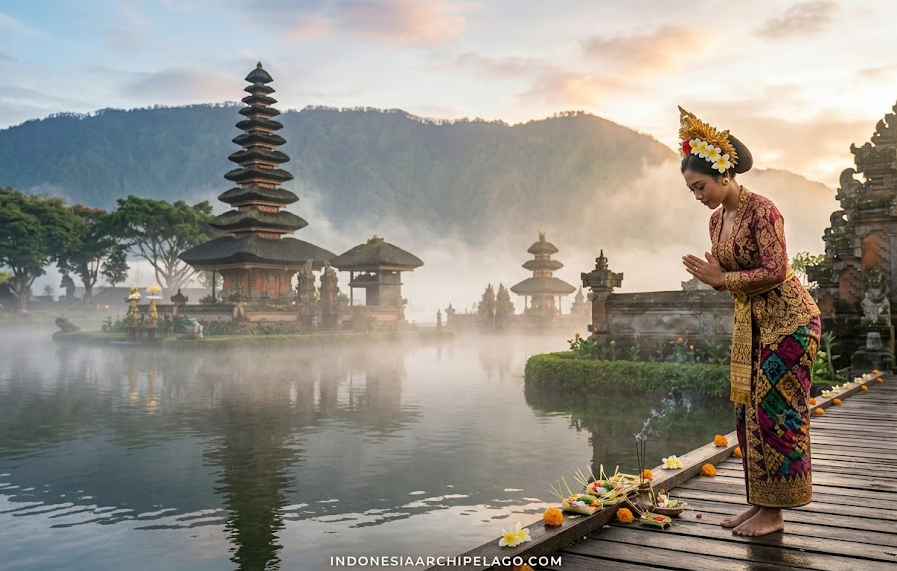
The sacred sunrise at Bali's iconic misty floating temple, Pura Ulun Danu Beratan, arrives before most travelers open their eyes. Lake Beratan sits at roughly 1,240 meters above sea level in the Bedugul Highlands, and the temperature at pre-dawn hovers around 16 to 18 degrees Celsius.
That cold, still air is the primary condition that generates the fog layer draped across the water each morning. The meru pagodas, particularly the 11-tiered shrine dedicated to Shiva and Parvati, emerge from that mist in a way that no midday visit can replicate.
This is not ambient aesthetics. The phenomenon follows specific atmospheric logic, and understanding it determines whether a photographer, a pilgrim, or a transit traveler extracts real value from the site.
The Golden Moment Window and Why It Closes Fast
The window for optimal golden light at Pura Ulun Danu Beratan is narrow. It runs from approximately 30 minutes before official sunrise to 45 minutes after, before the thermal differential between the lake surface and the rising air begins breaking the fog layer from above.
During this window, the water surface is glassy, the mist sits low and uniform, and the pagodas appear to genuinely float with no visible shoreline anchor. By 8:30 to 9:00 AM on most mornings, cloud formation from the highlands begins restructuring the sky in a way that eliminates the warm tonal quality entirely.
The golden light transforms the 11-tiered meru into something closer to a lacquered object than stone. Pura Ulun Danu specific quality does not return until the following dawn.
Fog Phenomenon of the Bedugul Highlands
The Bedugul Highlands operate under a microclimate shaped by the volcanic crater geography. Lake Beratan occupies what was once a volcanic caldera, and the surrounding terrain acts as a natural basin that traps cold air and moisture overnight. This is not random highland fog.
The density and persistence of the mist layer is directly tied to the absence of wind, the coolness of the lake water, and the degree of overnight cloud cover. Clear-sky nights in the dry season, roughly April through October, produce the most photogenic fog because the lake radiates heat into a clear atmosphere and cools rapidly.
The mist that forms is thicker, lower, and more photogenic under those conditions. During the wet season from November through March, water levels in the lake rise significantly, which pushes the pagodas closer to appearing fully surrounded by water, trading the dramatic fog for a more literal floating effect.
Spiritual Vibe: The Silent Morning Atmosphere
Before the entrance gates open and the tour groups consolidate at the main viewpoint, the area around the western shoreline of Lake Beratan holds a specific kind of silence. Balinese ceremony operates across a 210-day Pawukon calendar cycle, and during temple anniversary dates known as piodalan, offerings and incense are placed at the shrines well before dawn.
The scent of dupa incense and frangipani reaches the lakeside before light does. This is an active place of worship, not a preserved artifact. Locals from surrounding villages make regular visits to conduct subak-related rituals, as Lake Beratan functions as the primary irrigation source for rice fields across central Bali.
The Dewi Danu, goddess of lakes and rivers, is the presiding deity. The spiritual atmosphere present in the pre-dawn hour carries a density that mid-morning tourist traffic erases entirely. Arriving before the gates officially open, which guards sometimes allow on request, places a visitor inside that atmosphere rather than behind it.
Sacred Buddhist-Hindu Syncretism in One Complex
The temple compound contains something rarely foregrounded in standard travel narratives: a Buddhist stupa standing within a site classified as a Hindu Shaivite temple. This is not a renovation or a later addition for tourism. The stupa reflects the historical layering of Balinese religious identity, which absorbed Buddhist and Hindu Brahmanical traditions across centuries of trade and court influence.
Balinese Hinduism is not identical to Javanese or Indian Hinduism, and the doctrinal permeability that allowed a Buddhist structure to coexist within a complex dedicated to Shiva, Vishnu, Brahma, and Dewi Danu is specific to the Bali-Lombok religious corridor. The layout of the compound itself follows Lontar text principles, with three courtyards of ascending sanctity. The outermost courtyard functions as a secular buffer.
The innermost shrines, some only accessible by boat during high water, maintain active devotional use. Visitors observing ongoing ceremonies are expected to maintain physical and behavioral distance from ritual participants.

Secret Access and Roadside Photography Tips
The most-published photograph of Pura Ulun Danu Beratan does not come from inside the temple complex. It comes from the public road running along the western edge of Lake Beratan. A short stretch of roadside shoulder, accessible without any entrance fee, provides the angle that appears in most international travel media.
Standing at lake level on that shoulder during the golden hour gives a clean, unobstructed horizontal framing of the pagodas against the fog and mountain backdrop. This is a free spot with zero queuing. There is no ticket counter, no sarong requirement, and no crowd management infrastructure.
The limitation is that it requires arriving before 6:00 AM, because by 7:00 AM vehicle traffic and the opening of the formal complex begin to introduce movement and noise into the otherwise static scene. A wide-angle lens with a minimum focal length of 16mm captures both pagodas and the full mist layer in a single frame from this position.
Perspective from the Lake: Traditional Jukung Canoe Access
Boat access from within the lake produces a different compositional logic than shoreline photography. Traditional jukung outriggers, similar in structure to a canoe but stabilized by bamboo poles extending laterally, are available from a small kiosk located a few minutes south of the main temple entrance along the lakeshore road.
These boats do not require booking in advance. The departure point outside the formal temple complex charges only for the boat, not for temple entry, keeping the cost lower. From mid-lake, the pagodas are framed against the mountain ridgeline without any garden infrastructure visible in the frame.
The perspective compresses the vertical height of the 11-tiered meru against the fog layer in a way that makes it appear suspended rather than grounded. Morning boat operators tend to begin before 7:00 AM, and negotiating a departure time of 5:45 to 6:00 AM is feasible with direct communication the evening before.
Al-Hidayah Grand Mosque: The Hill Opposite the Temple Road
On the hill directly across from the road leading to Pura Ulun Danu Beratan, the Al-Hidayah Grand Mosque sits at an elevation that positions its minaret against the same highland skyline as the temple's pagodas.
The coexistence of these two structures within direct visual range of each other is the most immediate physical representation of religious plurality in the Bedugul area. Neither structure was built in reference to the other, but the visual relationship produced by the topography is sharp. At the call to Fajr prayer, which precedes sunrise by approximately 90 minutes, the sound reaches the lakeside.
For visitors already positioned at the shoreline before dawn, this audio layer adds a dimension to the pre-sunrise atmosphere that purely visual documentation of the site consistently omits. The mosque is accessible from the main Singaraja-Denpasar highway and serves the local Muslim community in Candikuning Village and surrounding areas.
Nearest Destinations: Eka Karya Botanical Gardens in 4 Minutes
Kebun Raya Eka Karya, Indonesia's largest botanical garden, sits approximately 1.5 kilometers from Pura Ulun Danu Beratan and is reachable in under 4 minutes by vehicle. The garden covers 157.5 hectares at an altitude between 1,250 and 1,450 meters above sea level, and contains over 21,000 living specimens across 2,400 species.
The collection includes more than 320 orchid varieties, over 180 fern species, carnivorous plant collections, and what is documented as the world's largest collection of begonias. Temperatures inside the garden range from 17 to 25 degrees Celsius during the day and drop to 10 to 15 degrees at night. It was established on July 15, 1959 and is operated by the Indonesian Institute of Sciences.
For a visitor already at the temple by 6:30 AM, the botanical garden opens before the morning heat builds and provides several hours of content before midday tourism volume at the lake temple becomes significant.

Bali Handara Iconic Gate: 3 KM and 5 Minutes North
The Bali Handara Gate in Pancasari Village sits approximately 3 kilometers north of Pura Ulun Danu Beratan along the main Singaraja-Denpasar highway. Drive time is 5 minutes under normal traffic conditions. The gate functions as the entrance to Handara Golf and Resort Bali, which was constructed inside the crater of an extinct volcano at approximately 1,400 meters elevation.
The gate itself is a traditional split Balinese candi bentar design, and its scale relative to the surrounding vegetation and mountain backdrop has made it one of the most photographed single structures in northern Bali. An entrance fee applies for the photo-op queue, and wait times on weekends can extend to 90 minutes.
The pre-dawn visit strategy that works at Ulun Danu does not transfer here because the gate's visual impact depends on daylight framing. The optimal sequencing for a single-day itinerary is: Ulun Danu at sunrise, botanical garden from 7:30 to 9:00 AM, then Handara Gate before 10:00 AM to manage queue length.
Wanagiri Hidden Hills and Lake Buyan at 15 Minutes
Wanagiri Hidden Hills is positioned approximately 8 kilometers north on the Singaraja road from Pura Ulun Danu Beratan, requiring about 15 minutes by vehicle. The hilltop site overlooks the twin lakes of Buyan and Tamblingan, which occupy adjacent volcanic craters at slightly higher elevation than Lake Beratan.
The perspective from Wanagiri places both lakes in a single frame against the northern Bali ridgeline. The site has developed extensive photo infrastructure including swings, bird nest platforms, and elevated wooden decks, all of which are oriented toward the twin lake panorama. Entrance fees apply. The Blooms Garden, another highland flower destination, sits approximately 7 kilometers from Ulun Danu and takes roughly 15 minutes to reach by the same northern route.
These two sites, combined with Handara Gate and the botanical garden, produce a coherent northern loop that can be executed within a single day from a Bedugul base or as an extended day trip from Ubud.
Strategic Position: Bedugul as the South-to-North Transit Axis
Bedugul's geographic position on the Singaraja-Denpasar highway makes it the primary land transit point between South Bali and the northern coast centered on Lovina. This is not incidental to its tourism function. The route from Denpasar to Singaraja passes directly through the Bedugul plateau, and every vehicle making that crossing passes within 500 meters of the Ulun Danu Beratan entrance.
For tour and travel operators designing multi-day northern Bali itineraries, Bedugul functions as both a destination cluster and a logistics node. The drive from Seminyak or Canggu to Bedugul takes approximately 2 hours under normal conditions. From Bedugul, Lovina Beach on the northern coast is approximately 45 minutes further.
This makes an overnight stay in Bedugul structurally logical for any itinerary that includes both southern Bali cultural sites and northern coast activities like dolphin watching at Lovina or the Banyumala Twin Waterfall.
Accommodation Options Across Budget Classifications
The Bedugul area offers lodging across several tiers without requiring a return to the southern resort corridor. At the premium end, Handara Golf and Resort Bali provides rooms and villas directly adjacent to its golf course at elevation, with mountain and forest views and temperature differentials that make the property functionally different from coastal Bali hotels.
Mid-range options include Anaheim Villa Lake Buyan and Munduk Sari Villa, both positioned for lake and mountain views at competitive rates relative to Seminyak comparables. Budget accommodation is available through Taman Rekreasi Bedugul, Kubu Strawberry Farm Bali, and several small guesthouses in Candikuning Village.
Strawberry Hill, located approximately 2 minutes from the Kebun Raya Eka Karya entrance, operates cabins suited to an overnight stay centered on an early sunrise visit to Ulun Danu. Staying in Bedugul eliminates the 2-hour pre-dawn drive that a day-trip visitor from the south must factor into an early arrival strategy, and gives direct access to the lake temple in the exact window when its visual and atmospheric conditions are most distinct.