

The giant manuscript of Borobudur is not a document stored in an archive. It is carved into 2,670 individual relief panels distributed across nine platforms of andesite stone on the Kedu Plain of Central Java. Reading it requires walking 3,000 meters of gallery corridors in sequence, beginning at the eastern stairway entrance and moving clockwise in pradaksina, the ritual circumambulation that mirrors the journey from the world of desire toward the formless absolute. Every surface of Borobudur Temple is a page. Most visitors read none of it.
Built between approximately AD 780 and 840 during the reign of the Shailendra dynasty, the structure covers 123 by 123 meters and contains no interior chamber for worship. It is a walking text, an architectural instruction manual for a spiritual transformation that begins at the buried foot and ends at an empty stupa at the summit whose original pinnacle design remains unknown.
Lost Lake Architecture: Geographic Insight
Borobudur was constructed on top of a natural hill that may once have been partially surrounded by a lake. Geophysical surveys conducted during and after the UNESCO restoration project between 1975 and 1982 identified sediment layers around the base of the monument consistent with a former lacustrine environment. This is not a purely academic detail. The presence of a lake or seasonal flood zone around the structure would have made Borobudur appear as a floating mandala from ground level during wet season months, transforming it visually into a lotus rising from water.
The Kedu Plain, in which Borobudur sits, is one of the most volcanically enriched agricultural zones in Java. The plain is enclosed by six volcanoes including Merapi and Merbabu to the east, Sumbing and Sindoro to the northeast, and the Menoreh Hills to the south. This basin geography creates a microclimate that generates morning mist layers during the dry season, turning the surrounding valley into a sea of fog from which the temple emerges. The visual effect from elevated viewpoints is not incidental. It is geographically consistent every morning between May and October.
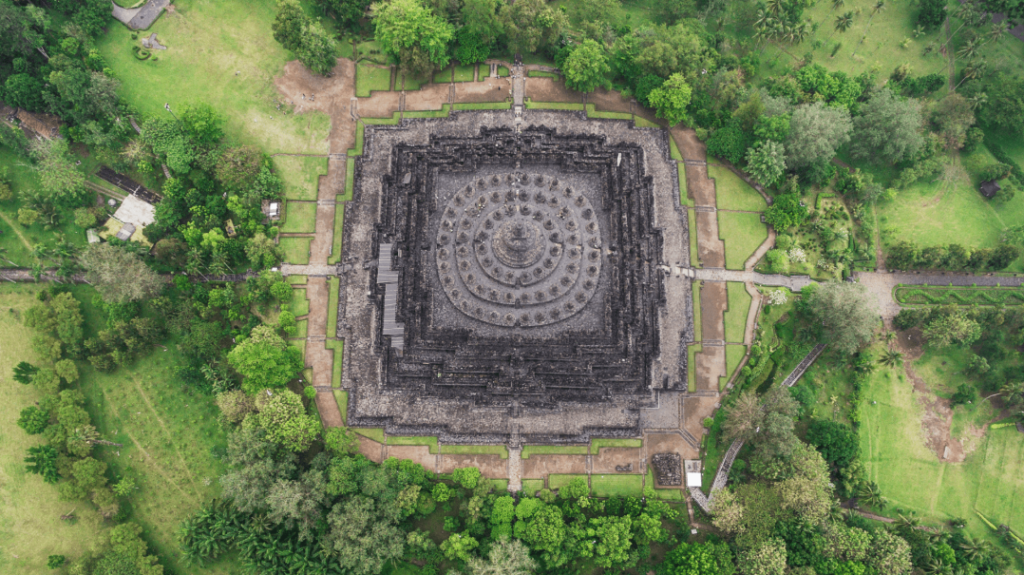
The Secret: Seen from Above, Borobudur Is a Mandala
Jika Anda melihat dari udara, Borobudur is a perfect mandala, a geometric diagram representing the Buddhist cosmos. The square base with four directional staircases corresponds to the four cardinal points. The circular upper platforms describe the formless sphere above material existence.
The central stupa at the top represents the point of nirvana. This mandala structure was not designed as an aerial spectacle, because no aircraft existed in the 9th century. It was designed as a diagram for internal mental navigation. Pilgrims did not view the mandala from outside. They walked through it, physically enacting the journey its geometry describes.
The mathematical precision of the mandala layout extends to the placement of 504 Buddha statues distributed across the balustrade niches of the five square platforms and the 72 perforated stupas of the three circular upper platforms.
Each directional Buddha displays a different mudra, or hand gesture, encoding a specific aspect of awakened awareness corresponding to its compass position. The geometric coherence of the entire system extends to the relationships between Borobudur and the two smaller satellite temples of Pawon and Mendut, which align with Borobudur along a single northeast to southwest axis stretching approximately 3 kilometers.
Hidden Relief of Kamadhatu and Karmawibhangga
The base of Borobudur contains 160 relief panels that have been buried under an encasement structure since the late construction phase of the monument, approximately 1,200 years ago. These panels illustrate the Karmawibhangga Sutra, the Buddhist law of cause and effect. The content is direct and graphic: scenes of killing, theft, rape, torture, and defamation paired with their karmic consequences, including detailed depictions of hell realms. On 35 of the 160 panels, brief inscriptions appear above the carvings, and these are considered by researchers to be the interpretive keys to the entire series.
Why these panels were buried is not definitively established. One scholarly position holds that the encasement was added as an engineering reinforcement to stabilize the base against soil movement. A second position, supported by the relief content, holds that the opening scene of the Karmawibhangga, which begins with graphic acts of violence rather than an auspicious invocation, was considered doctrinally incompatible with the Mahayana orientation of the monument's upper galleries.
A third position notes that the Hinayana self-reliance principle embedded throughout the Karmawibhangga reliefs, in which sufferers in hell receive no divine intervention, conflicts with the Mahayana emphasis on bodhisattva saviors depicted extensively in the third and fourth galleries above.
The encasement base was partially disassembled in 1885 by J.W. Ijzerman, and the full set of 160 panels was photographed by Kassian Cephas between 1890 and 1891. Those photographs are displayed at the Karmawibhangga Museum located several hundred meters north of the main temple within the Borobudur Archaeological Park. One corner of the encasement base has been permanently removed to allow direct visual inspection of a small section of the hidden foot.
Secret Routes Beyond the Magelang Main Road
The standard approach to Borobudur follows the main Magelang highway from Yogyakarta, passing through Muntilan before arriving at the northern entrance of the archaeological park. This route carries the majority of tourist vehicle traffic and concentrates congestion at predictable points, particularly on weekends and during the Vesak festival period. Three alternative routes reduce both travel time variability and road saturation.
The Nanggulan-Kalibawang route runs from the northwest of Yogyakarta through the Kulon Progo uplands, passing villages in the Kalibawang sub-district before descending into the Kedu Plain from the western side. This route intersects the Menoreh Hills terrain and passes through rural agricultural landscape with significantly less traffic than the Magelang corridor.
Travel time from Yogyakarta via this route is comparable to the main road but eliminates the Muntilan bottleneck. The Bedah Menoreh mountain tourism route traverses the ridge of the Menoreh Hills and offers intermittent views of the Kedu Plain and the Borobudur monument from elevated positions across the ridge.
It is used by motorcycles and small vehicles and connects to the western approach of the archaeological park. The Salaman-Tempel route enters from the south of Magelang Regency via Salaman district and crosses agricultural flatland before arriving at the park from the southwestern direction. This is the least-used of the three alternative approaches and is the most consistent for avoiding peak-hour vehicle clustering.
Sacred Geometry and the Enigma of Gunadharma
The architect attributed to Borobudur in Javanese tradition is Gunadharma, a name that translates as "virtue of the dharma." No inscription on the monument identifies Gunadharma by name. The attribution is carried through oral tradition and a legend that describes the architect as a figure of superhuman architectural knowledge who was physically transformed into a mountain after completing the structure. The mountain identified as Gunadharma's reclining profile is the Menoreh Hills range visible directly to the south of Borobudur. When viewed from the top of the monument, the ridge of the Menoreh Hills does trace a profile consistent with a reclining human figure.
The sacred geometry embedded in the structure extends beyond the mandala layout. The ratio of the base dimensions to the height of the original stupa pinnacle has been studied in relation to Mandala proportional systems described in Sanskrit architectural treatises, particularly the Manasara and Mayamata texts. The interlocking stone system, in which approximately 2 million blocks of andesite were assembled without mortar using a purely mechanical connection system of tenons and sockets, represents an engineering achievement without precise parallel in Southeast Asian antiquity.
The original pinnacle design of the central stupa was reconstructed by Theodoor van Erp during the 1907 to 1911 restoration, but Van Erp subsequently dismantled his own reconstruction on the grounds that insufficient original stone evidence supported his design. The dismantled chattra now sits in the Karmawibhangga Museum. The correct design of Borobudur's summit remains open.
Cosmos Level: Kamadhatu, Rupadhatu, Arupadhatu
The conventional three-realm division of Borobudur was first formally proposed by Willem Frederik Stutterheim in the early 20th century, based on partial data. Subsequent scholarship has questioned whether this framework has direct textual support within the monument itself, or whether it represents a modern interpretive overlay. Despite these academic reservations, the three-realm structure remains the most operationally useful framework for understanding the monument's vertical logic.
Kamadhatu, the world of desires, occupies the buried base. Its 160 panels depict the full spectrum of samsaric existence: desire, violence, consequence, and the endless recirculation of karmic cause and effect. That this level is hidden is consistent with its content. The world of desire is the foundation that the pilgrim stands on but is meant to transcend.
Rupadhatu, the world of forms, occupies the five square platforms. Its galleries carry 1,300 narrative panels across the first four galleries, including the 120-panel Lalitawistara sequence depicting the life of Siddhartha Gautama from his descent from the Tushita heaven to his first sermon at Benares, as well as the extensive Jataka and Avadana series of previous-life stories.
The transition from square to circular platform at the fourth gallery level marks the entry into Arupadhatu, the formless world, where narrative relief carving ceases entirely. The three circular platforms carry only the 72 perforated stupas and the central stupa at the summit. There is nothing to read here. The instruction is to arrive beyond reading.
Punthuk Setumbu: The Golden Hour Outside the Gate
Punthuk Setumbu is a hill approximately 4 kilometers west of Borobudur Temple in the village of Karangrejo, sitting at 400 meters above sea level. It is the primary external viewpoint for observing Borobudur during the pre-sunrise window, and it produces a compositional framing that the temple summit itself cannot replicate.
From the top of Borobudur, the viewer is standing on the subject. From Punthuk Setumbu, the viewer sees Borobudur in its geographic context: the monument nested within the fog-filled Kedu Plain, bracketed by the silhouettes of Mount Merapi and Mount Merbabu, with the Menoreh Hills range completing the southern frame.
The practical sequence for the golden hour window requires departing accommodation by 4:30 AM at the latest. The climb from the parking area to the hilltop viewpoint takes 15 to 20 minutes on a stepped concrete path. Sunrise at this latitude occurs around 5:40 AM during the dry season.
The actual visual sequence begins before sunrise when the valley fog is at maximum density, producing the layered mist effect that places Borobudur's silhouette within a cloud basin. Entry tickets are IDR 30,000 for international visitors. The site is operated by the local village and has a small coffee stall at the base. A subsequent visit to the temple itself can be sequenced immediately after, with the drive taking under 15 minutes.
Traditions and Arts Around the Borobudur Complex
The Soreng dance is a folk performance from the villages surrounding Borobudur that depicts a war narrative, specifically a battle scene involving soldiers, horses, and a commanding figure. Performed by male dancers in elaborate warrior costume including headdress and face paint, Soreng is a community performance tradition tied to village ceremony cycles rather than to the Buddhist heritage of the temple complex.
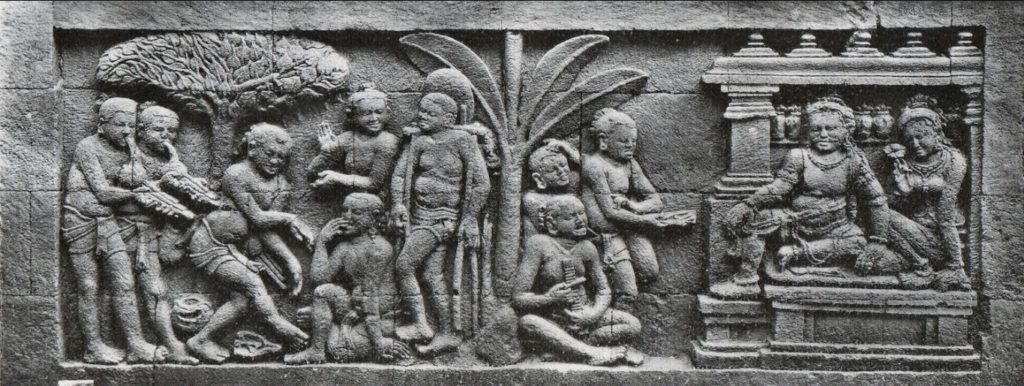
It is performed most frequently during village harvest celebrations and regional arts festivals in Magelang Regency. The Soreng performance does not follow a fixed annual calendar visible on tourist itinerary platforms. Attendance requires local knowledge of village ceremony schedules or coordination through community-based tourism networks operating in the Borobudur district.
The broader arts ecosystem surrounding Borobudur includes wayang kulit shadow puppet performance, traditional gamelan music, and batik production in surrounding villages. The PT Taman Wisata Candi complex that manages the archaeological park has hosted cultural performances including wayang events and poetry-puppet hybrid performances as part of its cultural programming, particularly during anniversary events.
These performances are documented in the park's official communications and represent the institutionalized layer of the art ecology rather than the village-based traditional performance circuit.
Vesak at Borobudur: World Energy Center and the Lantern Sky
The Waisak ceremony at Borobudur commemorates three events in the life of Siddhartha Gautama: his birth, his attainment of enlightenment, and his Parinirvana. The celebration follows the full moon day of the fifth or sixth month of the Buddhist lunar calendar, placing it in May or June of the Gregorian calendar. In 2026, Vesak falls on 31 May.
The ceremony begins days before the lantern release with the collection of holy water from the Umbul Jumprit spring in Temanggung and the retrieval of the eternal flame from the Mrapen gas flame in Grobogan Regency, Central Java. These elements travel to the temple complex in a formal procession.
The Kirab Waisak procession, in which thousands of Buddhist monks, nuns, and registered pilgrims walk approximately 3 kilometers from Candi Mendut to Borobudur, is the ceremonial spine of the event. The pradaksina circumambulation of the temple perimeter, performed clockwise three times as a gesture of devotion to the Buddha, Dharma, and Sangha, follows the procession.
The lantern release is the evening event that the site has become globally associated with. Thousands of biodegradable paper lanterns are released simultaneously into the night sky above the temple, each representing the dispersal of suffering, the aspiration for inner clarity, and a prayer for peace.
Borobudur is identified in the language of the ceremony's organizers as a world energy center, a site whose geographic and spiritual coordinates concentrate collective intention during the Vesak lantern moment in a way that makes the event structurally different from decorative lantern festivals held at secular venues.
The lantern release runs in two sessions: 6:00 PM to 7:30 PM and 8:30 PM to 10:00 PM. Tickets must be purchased in advance through Tiket.com or Traveloka. Dress code requires white clothing without shorts, short skirts, or sleeveless cuts.