
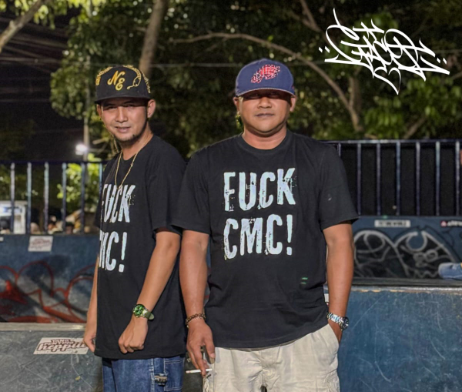
GACO is a rap group from Batu City, East Java, consisting of two members whose combined stage names became the identity of the project itself. Formed in 2023, the duo operates within the broader hip-hop landscape of Malang Raya — a region that encompasses Malang City, Batu City, and Malang Regency as an interconnected cultural and geographic zone.
While Batu City is administratively independent from Malang City, the hip-hop communities across these two cities have always shared stages, references, and lineage. GACO carries that shared history into a new formation with a clear mission: to preserve hip-hop subculture in Indonesia and rebuild the connections between the art community and the rap tradition.
The timing of GACO's formation is not incidental. Emerging in 2023, the group entered a hip-hop landscape that was experiencing both fragmentation and renewal across Indonesian cities.
Rather than waiting for external conditions to improve, Molga and Zico chose to create the formation they wanted to exist — and in doing so, added a new chapter to a regional scene that stretches back more than two decades.
Rap Music in Malang City and Batu City: A Shared Cultural Terrain
The relationship between Malang City and Batu City in terms of hip-hop culture operates more like a single ecosystem than two separate scenes. Batu City, sitting approximately 20 kilometers northwest of Malang City at higher elevation, has always had direct cultural exchange with the larger city's music and subculture communities.
Artists moved between the two, events drew from both talent pools, and the underground rap circuit treated administrative boundaries as irrelevant to who could participate.
Malang City carries the deeper institutional history of hip-hop in the region, with figures and crews whose activity dates back to the late 1990s. Batu City contributed its own layer of practitioners — artists who grew up in the highland city but absorbed the same cultural inputs from Malang's scene.
GACO emerges from that Batu City layer, carrying the region's collective hip-hop history while representing specifically the community that developed in the smaller, quieter city that most outsiders associate exclusively with tourism and apple orchards.
The Philosophy Behind the Name GACO
The name GACO is not arbitrary branding. It is a direct construction from the two members' stage names — Molga and Zico — with letters extracted and recombined to produce a group identity that carries both individuals within it. The logic of the name reflects a broader philosophy within the group: that the collaboration is not one artist with a supporting partner, but a genuine fusion where both identities are structurally present in everything the project produces.
This naming philosophy also signals how seriously both members treat the formation. When the name of a group is built from the names of its members, the group identity cannot be separated from individual accountability. Every output under the GACO name is simultaneously the output of Molga and Zico, without hierarchy and without the ambiguity that comes from a purely abstract group name.

Molga: From Breakdancing in 2006 to Rap in 2009
Molga's entry into hip-hop culture did not begin with rap. His first discipline was breakdancing, which he started in 2006 — a background that gives him a relationship with hip-hop as a complete culture rather than purely as a musical genre. Bboys develop a physical fluency with rhythm, timing, and performance presence that translates into how they approach the stage when they eventually move into other elements of the culture.
That foundation is audible in how Malang and Batu City artists who came through the bboy scene carry themselves differently from those who entered through music alone.
In 2009, Molga shifted his primary discipline to rap, bringing his years of movement-based hip-hop literacy into a vocal and lyrical practice. The transition from bboying to MCing is not uncommon in hip-hop communities where practitioners are immersed in the full culture.
The four elements inform each other, and artists who move between them carry a broader understanding of what makes hip-hop work as an integrated system. By the time GACO was formed in 2023, Molga had accumulated over fourteen years of active involvement in the regional hip-hop scene across two disciplines.
Zico: Over Two Decades in Rap Music Since 2001
Zico's career in rap music began in 2001, which places him among the earliest generation of active rappers in the Malang-Batu City region. Starting in 2001 means he was present during the foundational period when Indonesian hip-hop was developing its own voice independent of direct American imitation — a period when artists were actively working out what it meant to rap in Indonesian, in Javanese, and in the mixed linguistic registers that define everyday speech in East Java.
More than two decades of active practice in rap gives Zico a depth of experience that cannot be replicated by artists who entered the scene later, regardless of their talent. He carries institutional memory of what the scene looked like before streaming platforms changed distribution.
Before social media created new visibility channels, and before the current generation of Indonesian rap had the infrastructure it now takes for granted. That memory is a resource within GACO — it informs how the group positions itself and what reference points it draws from.
Soundstarz: The Music Producer Behind GACO's Sound
The formation of GACO was not simply a decision between two MCs to collaborate. Music producer Soundstarz is the third structural element that made the group's emergence possible. A producer in a rap group is not a technical support role — the producer defines the sonic identity that gives the MCs a platform to operate from, and the relationship between producer and rapper determines how cohesive a rap project sounds across multiple tracks.
Soundstarz represents the production layer that Molga and Zico needed to translate their combined lyrical and performance capacity into recorded output with a consistent aesthetic. The involvement of a dedicated producer from the group's formation — rather than working with different producers across different tracks — reflects a commitment to building a unified sound rather than a collection of loosely connected singles.

GACO's Unique Characteristic: Javanese Language Meets National Language
One of the most distinct characteristics of GACO's musical approach is the combination of Javanese regional language with Indonesian as the national language within the same tracks. This is not a novelty choice.
In the context of Malang and Batu City, Javanese — specifically the Arekan Javanese dialect of the region — is the actual first language of a significant portion of the community. Rapping in that language, or switching between it and Indonesian, reflects how people in this region actually speak.
The use of regional language in hip-hop has historical precedent across Indonesian scenes. Yogyakarta's hip-hop practitioners built an entire aesthetic around Javanese-language rap that drew international academic attention.
In Malang Raya, the local Arekan dialect carries its own sonic character — flatter in tone, more direct in register — that produces a different rhythmic texture when used in rap delivery compared to standard Indonesian.
GACO's approach to this linguistic layering is not regional novelty for its own sake. It is a reflection of authentic identity expressed through the most natural linguistic tools available to artists from this area.

Tumbak Cucukan: Daily Human Life Through the Lens of Gossip
GACO's track "Tumbak Cucukan" addresses one of the most universal social dynamics of everyday human life: gossip. The title itself draws from Javanese linguistic culture — tumbak cucukan is a phrase describing the act of provoking conflict through word of mouth, of carrying and amplifying interpersonal friction between people.
It is a behavior that appears in every social environment, and GACO's choice to address it through rap reflects the genre's original function as social commentary delivered through rhythm and lyrics.
The track is available on GACO's official YouTube channel, where it functions as public documentation of the group's sonic identity. For listeners unfamiliar with GACO, "Tumbak Cucukan" provides an immediate entry point into how the group handles lyrical content — grounded in the textures of daily life in East Java, using language that registers naturally within its cultural context.
Amidst the Ups and Downs of Indonesian Hip-Hop: GACO Dares to Return
Indonesian hip-hop has experienced significant cycles of visibility and contraction since the late 1990s. National peaks — periods when rap artists from Jakarta and Bandung reached mainstream audiences — have alternated with quieter phases when the genre retreated to regional underground scenes.
Regional communities like those in Malang Raya have navigated these cycles differently from major cities, because their scenes were never primarily dependent on national mainstream attention to sustain themselves.
GACO's formation in 2023 sits within one of those transitional moments in Indonesian hip-hop. The scene nationally was experiencing renewed energy, with younger artists gaining streaming audiences, while simultaneously the oldschool and mid-generation practitioners were reassessing what their continued involvement in the culture looked like.
For Molga and Zico — both with substantial histories in the scene — forming GACO was a direct response to that transitional pressure: a decision to produce rather than observe, to contribute rather than reminisce.
The Mission to Preserve Hip-Hop Subculture in Indonesia
GACO operates with an explicit preservation mission. The group's stated goal — to preserve hip-hop subculture in Indonesia and reconnect the art community and the rap tradition — frames their activity as cultural work rather than purely commercial music production. This distinction matters in how the group approaches its output, its collaborations, and its positioning within events like Malang Kembali Hip-Hop.
Preservation in the context of hip-hop subculture does not mean freezing the culture in a particular historical moment. It means maintaining the connection to the values, practices, and community orientation that gave hip-hop its original social function.
Belonging expression from within a community, accountability to that community, and resistance to the dilution that comes when a subculture is processed purely for commercial extraction. GACO's dual background across bboying, rap, and extended scene involvement positions them to carry this mission with credibility that newer acts cannot claim.

Reconnecting the Art Community and the Rap Tradition
Beyond preservation, GACO carries a reconnection mission — specifically between the art community broadly understood and the rap tradition in their region. Over time, as hip-hop fragmented into increasingly specialized sub-genres and as its commercial mainstream moved further from underground practice, the connections between different disciplines within the culture weakened in many regional scenes.
Bboys, graffiti writers, DJs, and MCs who once operated as a unified community began to occupy separate spaces with decreasing overlap. GACO's positioning within this context reflects an awareness that rap cannot sustain its cultural depth in isolation from the other elements that give it meaning.
A rapper who has no relationship with the bboy community, no awareness of what graffiti writers are producing, and no engagement with the DJ scene that provides the sonic foundation of the culture is producing music within a hip-hop frame but outside hip-hop culture. Molga's background in bboying makes this reconnection mission something GACO can pursue from lived experience rather than theoretical commitment.
Established in 2023: Building a New Chapter on Deep Foundations
GACO's 2023 formation date places the group in an interesting temporal position within the Malang Raya hip-hop narrative. They are a new formation, but neither of their members is new to the scene. The combination of Zico's 22-year rap history and Molga's cross-disciplinary background dating to 2006 means GACO enters the field as a debut act with the accumulated experience of veteran practitioners.
That asymmetry between institutional newness and individual depth is one of the group's structural strengths. For the regional scene, a formation like GACO provides continuity between eras that might otherwise disconnect.
Younger artists entering Batu City and Malang City's hip-hop communities now have a visible reference point that bridges the 2000s scene with current practice — an active group whose members were present during formative periods and who are now producing contemporary work rather than curating memories.
GACO and the Future of Batu City Hip-Hop
Batu City's cultural identity in national discourse is dominated by its tourism assets — the theme parks, highland nature, and agricultural products that draw visitors from across Java. The existence of a rap group with GACO's mission and background within Batu City's community does not change that external image overnight, but it adds a layer to the city's cultural output that is often invisible to outsiders.
Hip-hop in Batu City has always coexisted with the city's dominant tourism character, operating in the spaces that visitors do not access — the residential neighborhoods, the community gathering points, the social infrastructure of young people who grew up in the city rather than visited it.
GACO makes that layer audible and, through platforms like their YouTube presence and appearances at regional events, increasingly visible. The group's work is a reminder that East Java's creative culture extends beyond the assets that tourism brochures document.