

Pontianak City holds a geographic distinction that no other Indonesian provincial capital shares it sits directly on the equatorial line, where zero degrees latitude bisects the urban fabric, splits the Kapuas River delta, and gives the city an identity anchored in both cartographic fact and centuries of multicultural trade. As the capital of West Kalimantan Province, the city governs a vast territory stretching across western Borneo to the Malaysian border, yet its own municipal footprint covers roughly 118 square kilometres of low-lying riverine terrain built on marshland, stilted wooden structures, and the relentless logistics of two major rivers.
What makes Pontianak compelling as an urban destination is the density of its cultural layering of three dominant ethnic communities whose fusion has produced a language, a festival culture, a craft tradition, and a culinary identity that exists nowhere else in the archipelago.
Pontianak City on the Map of West Kalimantan's River Geography
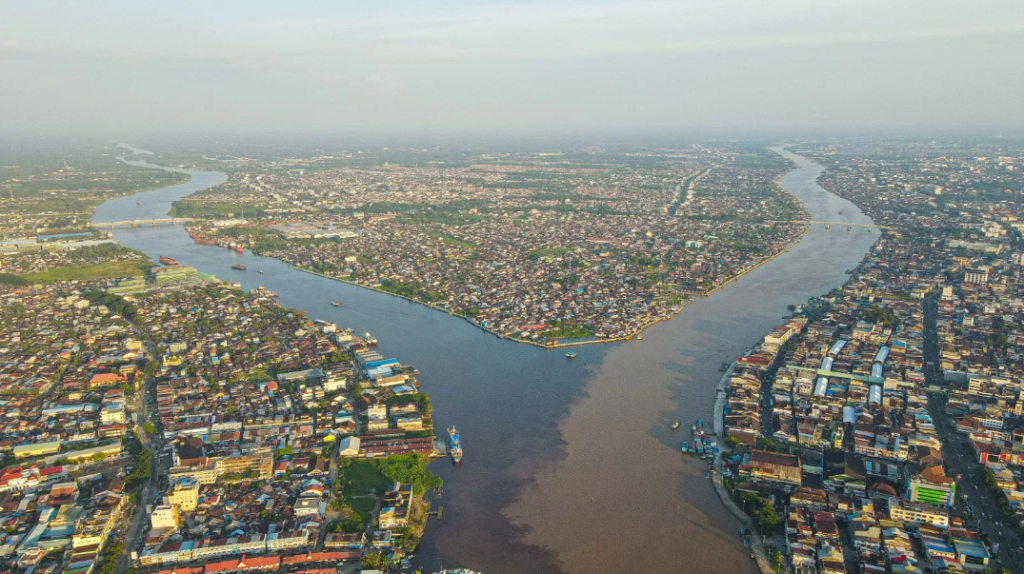
The municipality sits at the confluence of the Kapuas and Landak rivers, on the western coast of Borneo roughly 20 kilometres inland from the Java Sea shore. The Kapuas at approximately 1,143 kilometres the longest river in Indonesia defines the city's orientation, transportation logic, and flood vulnerability in equal measure.
The urban terrain is almost entirely flat, positioned within the river delta's alluvial plain at near-zero elevation, which subjects low-lying neighbourhoods to regular tidal flooding during peak wet season periods.
Administratively, Pontianak City operates as an independent municipality separate from the surrounding Mempawah and Kubu Raya regencies. It is divided into six kecamatan and functions as the provincial command center for West Kalimantan's governance, judicial, and commercial infrastructure.
The broader province it governs spans over 147,000 square kilometres the second largest province in Indonesia by land area with the city serving as the primary gateway for the interior regencies that remain dependent on the Kapuas river system for goods movement and communication links to the coast.
From the Cannon Shot Founding Legend to the Kadriyah Sultanate
The founding narrative of Pontianak carries an origin story embedded in both history and local mythology. Sultan Syarif Abdurrahman Alkadrie, an Arab-Malay nobleman of Hadhrami descent, arrived at the Kapuas delta in 1771 after a journey along the river from the interior.
According to the foundational account, the future sultan fired cannon shots to drive away kuntilanak spirits — the source of the city's name from the marshy junction of the Kapuas and Landak rivers. Where the cannon fire struck marked the chosen settlement site, and on October 23, 1771, the Sultanate of Kadriyah was formally established.
The sultanate rapidly developed into a significant trading hub, attracting Chinese merchants, Bugis traders, Javanese migrants, and Dutch commercial interests. The VOC established a formal agreement with the sultanate in the late 18th century, beginning a colonial relationship that would eventually absorb the kingdom into the Dutch East Indies administrative system.
During the Japanese occupation from 1942 to 1945, the sultanate suffered catastrophic losses in what became known as the Pontianak Incidents mass executions carried out by the Japanese military that killed the reigning sultan alongside hundreds of the regional elite, leaving a rupture in the city's institutional continuity that shaped its postwar political character.
Following independence, Pontianak assumed its role as provincial capital and steadily expanded through land reclamation, bridge construction, and port infrastructure investment.
Tidayu Harmonization and the Three-Culture Foundation of Pontianak
The social identity of Pontianak rests on the Tidayu framework, an acronym and cultural concept representing the three primary ethnic communities of West Kalimantan: Tionghoa (Chinese), Dayak, and Melayu (Malay). Rather than existing as parallel communities with only occasional intersection, the three groups in Pontianak have produced genuine cultural synthesis across generations of shared commerce, intermarriage, and neighborhood proximity.
Tidayu concept formalized this synthesis into a regional identity marker, producing collaborative artistic forms most visibly in Tidayu batik, which integrates dragon and fan motifs from Chinese textile tradition with fern frond and shield patterns from Dayak craft and bamboo shoot floral designs from Malay weaving.
The Malay community centers its cultural identity around Islamic practice, the Kadriyah Palace heritage, and coastal maritime tradition. The Dayak population, more concentrated in the interior regencies than in the city proper, contributes agricultural ceremonial culture and the Gawai harvest festival to the broader West Kalimantan calendar.
The Chinese Indonesian community, among the largest proportionally of any Indonesian provincial capital has shaped the commercial landscape of Pontianak since the sultanate era, establishing trading networks, coffeehouse culture, and the Teochew culinary tradition that remains central to the city's food identity today.
Pontianak Malay, the Teochew Register, and Daily Street Language
The primary spoken language of Pontianak's daily commercial and community life is Pontianak Malay, a dialect of the broader Malay language family that carries phonetic and lexical distinctions separating it from both standard Indonesian and the Malay dialects of Peninsular Malaysia.
Pontianak Malay dialect shows significant Teochew Chinese borrowing, particularly in vocabulary relating to food, trade, and kinship terms — a direct reflection of centuries of Chinese-Malay commercial interaction along the Kapuas waterfront.
Teochew, the dialect of Min Chinese spoken by the dominant subgroup of the Chinese Indonesian community in Pontianak, functions as a full community language alongside Indonesian in the city's older commercial districts, particularly around Jalan Gajah Mada and the waterfront trading areas. Younger generations increasingly use Indonesian as their primary language while retaining passive Teochew and Pontianak Malay competence.
The linguistic environment of daily Pontianak therefore operates across at least three registers simultaneously: Indonesian for institutional and formal contexts, Pontianak Malay for inter-ethnic community communication, and Teochew for internal Chinese community interaction in market and family settings.
Tugu Khatulistiwa, the Kadriyah Palace, and the City's Defining Landmarks
The Equator Monument locally known as Tugu Khatulistiwa stands at Siantan in the northern section of Pontianak, on the bank of the Kapuas River directly on the zero-degree latitude line. The original modest Dutch monument, erected in 1928 to mark the precise equatorial crossing point, was enclosed within a larger concrete dome structure in 1991 that also houses a giant replica of the original.
Twice yearly, during the solar culmination events of the vernal and autumnal equinoxes in March and September, the sun passes directly overhead at solar noon, causing shadows of the monument and surrounding vertical objects to disappear completely for several minutes, a phenomenon that draws visitors specifically for the equinox events.
Istana Kadriyah, the Kadriyah Palace, stands across the Kapuas in the Dalam Bugis neighborhood and represents the oldest surviving royal structure in West Kalimantan. The palace's bright yellow wooden construction characteristic of Malay royal architecture houses the original sultan's throne, royal regalia, period weaponry, and Portuguese-era cannon.
Adjacent to the palace, the Masjid Jami Sultan Abdurrahman, built in the same founding period of 1771, remains an active congregational mosque and the oldest in the province. Together, the two structures form a heritage compound that grounds Pontianak's founding narrative in tangible architectural form.
Kapuas River Cruises, Heritage Villages, and Waterfront Tourism
The Kapuas River is not only the city's logistical spine, it is also its primary tourism corridor. River cruise operations running from the Pontianak city waterfront allow visitors to observe the stilted riverside communities, traditional fishing villages, and floating market clusters that remain active along the riverbanks despite increasing road connectivity.
The Kampung Beting area, one of the oldest riverside settlement zones in the city, preserves traditional Malay stilted house architecture and functions as a de facto heritage village within the urban boundary.
Floating markets operating on tributaries within the broader Pontianak region most notably in the Sungai Kakap area south of the city replicate the riverine commerce model that defined Kapuas delta trade for centuries.
Boat tours departing from the Seng Hie waterfront area provide access to both the Tugu Khatulistiwa monument across the river and to the older commercial wharves where traditional wooden vessels still load and unload freight alongside modern container equipment.
Cap Go Meh Festival, Tatung Performance, and Modern Recreation Areas
Cap Go Meh Festival held on the 15th day after the Lunar New Year is the largest and most internationally recognized cultural event in Pontianak. The festival's most distinctive feature is the Tatung procession, in which Dayak performers dressed in traditional Dayak attire enter a trance state and demonstrate apparent physical imperviousness to sharp blades, needles, and fire.
The cross-ethnic nature of the Tatung performance, a Chinese ceremonial context performed by Dayak participants, makes it the single most visible expression of the Tidayu cultural synthesis in action, drawing visitors from across Kalimantan, Peninsular Malaysia, and Singapore annually.
Gajah Mada area in Jl. Gajah Mada and its surrounding commercial streets function as the city's primary entertainment and culinary business corridor, particularly after dark. The street concentrates coffee shops, night market stalls, seafood restaurants, and the legendary old-school warkop (coffee house).
Establishments that anchor Pontianak's food culture, modern recreational spaces including the Alun-Alun Kapuas riverside promenade and the Taman Alun Kapuas have been developed to provide structured public leisure infrastructure along the city's primary waterfront.
Gill Pattern Craft, Silver Weaving, and Pontianak's Creative Sector
The creative industry sector in Pontianak is anchored by Tidayu craft production, with the gill-patterned (motif insang) textile being the most commercially prominent output. The insang motif — derived from the visual structure of fish gills and rendered in geometric repetition across woven and printed fabric is recognized as the primary craft identity of Pontianak and appears on batik cloth, songket weaving, embroidered accessories, and decorative household products marketed to both domestic tourism buyers and export markets.
Government-backed craft development programs have invested in motif documentation, weaver training, and market access development to formalize the insang textile economy.
Alongside textiles, Pontianak hosts active wood carving, rattan weaving, and traditional boat building craft communities distributed across the riverbank neighborhoods.
The Cap Go Meh festival economy generates significant demand for lantern production, paper craft, and ceremonial object manufacturing in the months preceding the annual event, sustaining a seasonal creative employment base that complements the year-round textile and souvenir craft sector.
Giant Aloe Vera, Rubber, and Coconut as West Kalimantan's Commodity Base
Pontianak is synonymous in Indonesian agricultural markets with giant aloe vera cultivation, the oversized lidah buaya variety grown in peat soil conditions around the city's periurban zones that produces leaf weights multiple times larger than standard commercial varieties.
Processed aloe vera products from Pontianak drinks, gels, confectionery, and cosmetics have achieved national distribution and form one of the most recognized regional commodity brands in Kalimantan. The cultivation zone covers thousands of hectares in Kubu Raya Regency immediately south of the municipal boundary.
Natural rubber remains a foundational commodity of West Kalimantan's broader economy, with smallholder rubber farms covering extensive areas across the interior regencies and channeling production through Pontianak's commodity trading networks.
Coconut cultivation along the coastal and riverine zones of the province supplies copra, coconut oil, and fresh coconut products to processing facilities and export commodity traders operating through the Dwikora and Kijing port systems.
The combination of aloe vera, rubber, and coconut positions Pontianak's commodity hinterland as a producer of tropical agricultural goods with both domestic consumption and export pathway relevance.
Coffee Culture, Sotong Pangkong, and the Chai Kue Tradition
Pontianak's culinary identity runs on coffee. The warkop culture — daily congregational coffee consumption at open-fronted street-level coffee shops is not a tourist amenity but a foundational social institution that structures morning and evening community interaction across ethnic lines.
The most storied establishments concentrate along Jalan Gajah Mada, where families have been roasting and serving Pontianak-style kopi for generations using robusta beans blended with margarine and sugar in proportions calibrated to local taste preferences. The practice of drinking coffee in a warkop is how business deals are discussed, neighborhood news is exchanged, and the city's daily social fabric is maintained.
Sotong Pangkong dried cuttlefish pounded flat and grilled over charcoal until crispy, served with a sweet-spicy peanut sauce is the street food most associated with Pontianak's Ramadan night markets, though it has become available year-round through permanent stalls and packaged souvenir products.
Chai kue, the Teochew-origin steamed rice flour dumpling filled with jicama, chive, or dried shrimp, operates as the city's most identifiable dim sum product and is consumed as daily breakfast food rather than as a special occasion dish.
The three culinary anchors coffee, sotong pangkong, and chai kue span all three ethnic communities and reflect the genuine cross-cultural food integration that the Tidayu framework describes.
Commodity Companies, Regional Enterprises, and the Pontianak Business Landscape
The commercial economy of Pontianak is structured around commodity trading, government contracting, and the distribution functions that flow from its role as provincial capital. Large commodity corporations handling rubber, palm oil, bauxite, and timber operate regional head offices in Pontianak, managing supply chains that originate in the interior regencies and terminate at the Dwikora Port or the newer Kijing Terminal in Mempawah.
State-owned enterprises including the Pontianak branches of Bank BRI, Bank BNI, and Bank Mandiri, alongside Bank Kalbar as the provincially owned financial institution anchor the formal banking sector.
The regional government-owned enterprise portfolio includes PDAM Tirta Khatulistiwa for water services, and PT Kalbar Energi for power and energy resource management.
The city's retail commercial landscape is anchored along Jalan Ahmad Yani and the newer mall developments in the southern district, with the Gajah Mada corridor retaining its role as the primary independent retail and food service street economy.
Shipbuilding Tradition and the Kapuas River Docking Infrastructure
Traditional wooden boat building has been practiced along the Kapuas riverbanks for as long as the city has existed. The boatyard clusters concentrated in the Sungai Jawi and Batu Layang areas north of the city center construct and repair the wooden cargo vessels, passenger ferries, and fishing boats that continue to operate on the Kapuas and its tributaries as the primary transport mode for communities that road infrastructure has not yet reached.
Ulin ironwood, the dense, water-resistant Borneo hardwood that has defined riverine construction in Kalimantan for centuries — remains the material of choice for traditional vessel construction despite restricted supply due to forestry regulations.
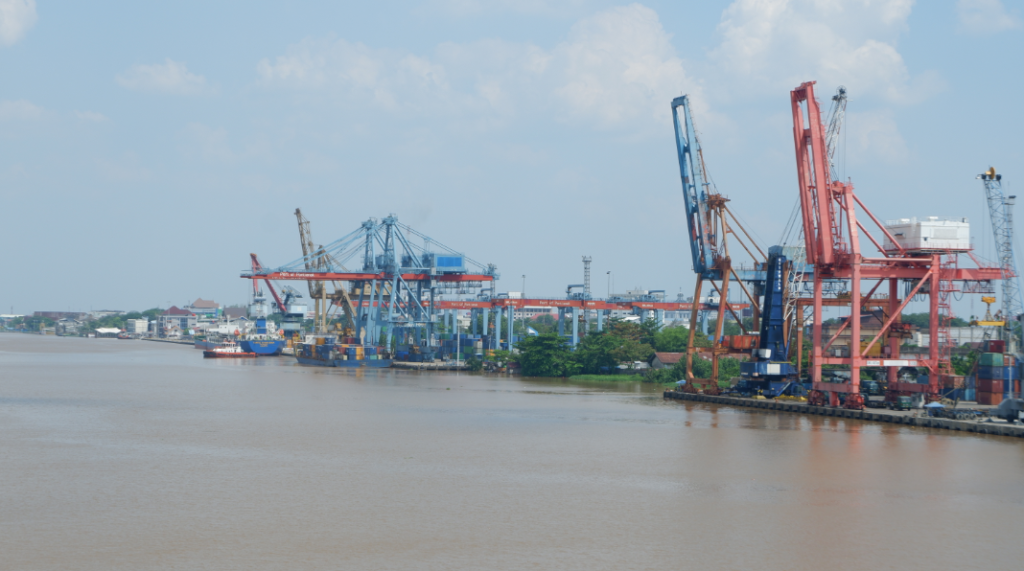
Dwikora Port, operated by Pelindo through its Pontianak branch, provides the primary formal docking infrastructure for cargo vessels operating within the Kapuas river channel. The port handles container, bulk, and general cargo on domestic routes to Jakarta, Surabaya, Batam, and other major Indonesian hubs.
The river channel's chronic sedimentation problem requiring annual dredging expenditure in the tens of billions of rupiah is the primary operational constraint that drove the construction of the Kijing Terminal as an offshore alternative.
Supadio Airport, the Kapuas Bridge Network, and Road Connectivity
Supadio International Airport, located in Kubu Raya Regency approximately 17 kilometres south of the city center, serves as the primary air gateway for West Kalimantan. The airport handles domestic routes to Jakarta, Surabaya, Balikpapan, and other major Indonesian cities, as well as international services to Kuching in Malaysian Sarawak.
Runway and terminal expansion investments have progressively upgraded Supadio's capacity to handle the growing passenger volume driven by the province's economic development trajectory.
Road connectivity within Pontianak and across the Kapuas River system relies on three bridge crossings Kapuas Bridge I, operational since 1982 as the first fixed crossing over the Kapuas in the city; Kapuas Bridge II, added in the 2000s to relieve traffic pressure on the original crossing; and Kapuas Bridge III, the most recent addition extending connectivity toward the northern Siantan district.
The Trans-Kalimantan Highway running eastward from Pontianak toward Sanggau, Sintang, and ultimately connecting to Central and East Kalimantan constitutes the primary land logistics spine of the western Borneo hinterland, with Pontianak as its western terminus.
River-Sea Logistics Axis and Pontianak's Trans-Kalimantan Western Role
The logistics architecture of Pontianak operates across two axes simultaneously. The river-sea axis moves commodities from the interior down the Kapuas tributary system to Pontianak's port infrastructure, where they transfer to coastal shipping bound for Java, Sumatra, and international markets. This axis has functioned since the sultanate era and remains the dominant freight mechanism for rubber, palm kernel, and timber moving out of the interior regencies.
The overland axis running eastward along the Trans-Kalimantan corridor through Sanggau toward Entikong at the Malaysian border and beyond carries cross-border trade and positions Pontianak as the western anchor of Kalimantan's road-based freight network.
Entikong land border crossing with Malaysian Sarawak, approximately 400 kilometres east of Pontianak, processes significant bilateral trade and labor movement between West Kalimantan and East Malaysia, with Pontianak functioning as the supply and service base for the border economy.
Pontianak-Singkawang toll road project, when completed, will reduce travel time between Pontianak and the northern coastal cities while providing direct high-speed road access to the Kijing Terminal site in Mempawah, integrating the port's hinterland reach with the provincial capital's logistics command infrastructure.
Kijing International Terminal and the Future Hinterland Integration
The Kijing Terminal, inaugurated in August 2022 and located in the Mempawah district approximately 80 kilometres north of Pontianak city center, represents the most significant port infrastructure investment in West Kalimantan's history.
Built at a construction cost exceeding US$195 million and operated by Pelindo through its non-containerized cargo subsidiary, the terminal is designed to handle up to 1.95 million TEUs annually and can berth vessels up to 100,000 deadweight tons using a 15-metre deep channel that eliminates the sedimentation constraints of the Kapuas river approach.
The terminal's direct coastal position on the Karimata Strait places it on the natural shipping lane between Singapore, Peninsular Malaysia, and Indonesian archipelago ports.
The Kijing Terminal's commodity mix reflects West Kalimantan's production profile — crude palm oil, bauxite, alumina, rubber, and containerized agricultural products constitute the primary cargo streams. The terminal handles up to 15 vessels simultaneously across its container, dry bulk, multipurpose, and liquid bulk berths, with projected cargo growth linked directly to the bauxite and alumina processing investments expanding in the Mempawah and Landak regency industrial zones.
National spatial planning frameworks position Kijing Terminal as a strategic hub port within Indonesia's sea highway program, tasked with capturing commodity flows that previously transited through Tanjung Priok in Jakarta or Dumai in Riau a diversion that cuts provincial logistics costs by an estimated 30 percent per export shipment.