

Manokwari City stands as the administrative capital of West Papua Province, positioned on the Bird's Head Peninsula of New Guinea Island and shaped by a layered history that moves from nineteenth-century missionary settlement through colonial administration to its current function as a provincial government center and logistics hub serving one of Indonesia's most resource-rich eastern regions.
Geographical Position, Topography, and Regional Administrative Division
Manokwari City sits at approximately 0°51' South latitude and 134°5' East longitude on the northeastern coast of the Bird's Head Peninsula, facing Doreri Bay and flanked by the Arfak Mountains to its southern and interior edges. The coastal margin is narrow, with the terrain rising steeply into forested highland within a short distance from the shoreline, creating an urban geography compressed between bay and mountain. Several rivers drain from the Arfak range through the city's territory toward Doreri Bay, historically defining settlement corridors and freshwater access zones.
Administratively, the city is organized into subdistricts and wards under the municipal government framework, managing public services and land use across a territory that has expanded its built-up area steadily since West Papua Province was formally established in 2003.
From Mansinam Island in 1855 to the Capital of West Papua
The documented history of Manokwari City as a significant settlement begins with the arrival of German missionaries Carl Wilhelm Ottow and Johann Gottlob Geissler on Mansinam Island in February 1855, marking the first permanent Christian mission station in New Guinea. This event established Mansinam as the entry point of formal Western religious and educational influence into the Papuan interior, and its significance continues to define Manokwari's identity as a city with deep Protestant Christian roots distinct from most Indonesian provincial capitals.
Dutch colonial administration subsequently developed Manokwari as a regional administrative post, using the natural harbor of Doreri Bay as the operational base for governance over the Bird's Head territory. Infrastructure investment during the colonial period concentrated on the coastal zone, establishing port facilities, administrative buildings, and mission-linked educational institutions that formed the city's early urban core.
Following Indonesian integration of West Irian in 1963 and subsequent provincial reorganizations, Manokwari was designated as the provincial capital of West Papua Province upon its establishment in 2003, accelerating government office construction and in-migration from other Indonesian provinces.
Majority Ethnicities, Multicultural Bonds, and the Spirit of Tolerance
Manokwari City hosts a demographically diverse population where indigenous Papuan ethnic groups, including the Arfak, Doreri, Wamesa, and Biak communities, coexist with significant migrant populations from Java, Sulawesi, Maluku, and other Indonesian provinces.
The Arfak people hold a particularly prominent cultural position given their ancestral territorial connection to the Arfak Mountains and the coastal lowlands where Manokwari City is built. Their customary land rights and ceremonial traditions remain active reference points in local governance and community relations.
The city's multiethnic composition has produced a social environment where tolerance and inter-community negotiation are practical necessities rather than abstract values. Religious diversity is managed through established inter-faith forums, and both Christian and Muslim communities maintain significant institutional presences in the city's social infrastructure.
Provincial government communications consistently frame this multiethnic coexistence as a defining characteristic of West Papua's civic identity, and Manokwari functions as the most visible demonstration of that framing within the province.
Papuan Dialects, Language Patterns, and the Everyday Use of Kaka
The linguistic landscape of Manokwari City reflects its ethnic diversity, with Papuan languages including Arfak, Biak, and Wandamen spoken alongside Indonesian as the dominant public communication medium. The Arfak language family encompasses several related dialects spoken across the mountain communities surrounding the city, while coastal Papuan languages show distinct phonological and lexical profiles influenced by centuries of maritime contact and trade interaction.
The colloquial address term "kaka," derived from Malay and widely used across Eastern Indonesia, functions in Manokwari's everyday speech as an informal second-person address and a marker of social familiarity across ethnic lines.
Its use extends beyond age-based respect conventions and operates as a general-purpose friendly address between peers, strangers in market settings, and colleagues in informal workplace communication.
The term anchors a local sociolect that blends Papuan vocabulary, Indonesian, and Eastern Indonesian colloquialisms into a distinctly Manokwari urban vernacular recognizable across the city's subdistricts.
Mansinam Site, Arfai Governor's Office, and the Welcome Monument
Mansinam Island remains the most symbolically significant historical site connected to Manokwari City, accessible by short boat crossing from the city's waterfront. The island holds the graves of Ottow and Geissler, a reconstructed mission chapel, and a large cross monument erected on elevated ground visible from the mainland.
The site draws religious pilgrims, particularly during the annual Gospel Day commemoration on February 5, which is observed as a public holiday in West Papua Province and attracts visitors from across the region.
The Arfai Governor's Office complex occupies a prominent hillside position overlooking the city and Doreri Bay, serving as the administrative center of West Papua Province. Its elevated siting gives it visual dominance over the urban landscape and reinforces its symbolic function as the seat of provincial authority.
The Welcome Monument, located at a key entry point into the city's central zone, marks civic identity and functions as a standard reference landmark for orientation within Manokwari's urban geography.
Arfak Mountains Reserve and Doreri Bay Marine Ecotourism
The Arfak Mountains Nature Reserve constitutes one of the most ecologically significant protected areas in West Papua, encompassing montane forest ecosystems that support exceptionally high biodiversity including numerous endemic bird species. The reserve borders Manokwari City's southern and inland territories, making it one of the few Indonesian provincial capitals with a major nature reserve accessible within a short drive from the urban center.
Birdwatching tourism targeting Wilson's bird-of-paradise and other Arfak endemic species has developed into a specialized visitor segment drawing international wildlife tourists to the Arfak Mountains area.
Doreri Bay provides a contrasting marine ecotourism environment on the city's immediate coastal front. The bay's coral reef systems, fish diversity, and calm inshore waters support snorkeling, diving, and traditional fishing tourism activities.
Local operators offer boat-based reef tours departing from Manokwari's waterfront, and the bay's visual prominence as a backdrop to the city's built environment makes it a consistent feature of Manokwari's tourism identity communications across both provincial and national platforms.

Hadi Mall and the Cafe Lifestyle Along Amban's Urban Corridor
Hadi Mall serves as Manokwari City's primary enclosed retail destination, consolidating brand retail outlets, food court facilities, and entertainment options within a single commercial structure. Its presence has concentrated urban consumption activity and established a modern retail anchor point that shapes commercial patterns across the surrounding subdistricts.
The mall functions as a social infrastructure node particularly relevant to Manokwari's growing middle-income population of government employees, private sector workers, and university students.
The Amban area has developed as a distinct urban lifestyle corridor where independent cafes, small restaurants, and casual retail businesses line the main road serving the Universitas Papua campus zone. The cafe concentration along this corridor reflects a pattern common to Indonesian university towns, where student and young professional populations generate consistent demand for affordable social spaces outside the home.
Manokwari's cafe scene has developed a local character incorporating Papuan coffee varieties sourced from Ransiki and other West Papua highland production areas, connecting urban consumption directly to the province's agricultural commodity base.
Noken Craft Tradition and the Thousand-Legged House Architecture
Noken, the traditional string bag of Papuan culture, holds UNESCO Intangible Cultural Heritage status and remains one of the most recognized material culture expressions associated with Manokwari and West Papua broadly. Produced by women using manual knotting and looping techniques with natural plant fiber or commercial yarn, noken carries functional, ceremonial, and identity significance across Papuan communities.
In Manokwari City, noken production and sale operate through market stalls, craft shops, and community cooperatives, with the object serving simultaneously as everyday utility item, cultural symbol, and tourism souvenir.
The Thousand-Legged House, a traditional raised longhouse structure built on numerous wooden stilts, represents the architectural heritage of coastal Papuan communities and appears in both preserved heritage contexts and contemporary craft reproductions within Manokwari.
Scale models and structural motifs drawn from this architectural tradition are produced by local craftspeople as decorative objects and cultural education tools, feeding into the city's creative industry sector alongside noken production and other indigenous craft forms.
Ransiki Cocoa, Merbau Timber, and Palm Oil Commodities
Manokwari City functions as the collection and logistics coordination hub for several of West Papua's primary agricultural and forestry commodities. Ransiki cocoa, produced in the Ransiki sub-region of Manokwari Regency, has developed recognition within Indonesian specialty cacao markets for its flavor profile and processing quality. Cacao from this production zone moves through Manokwari's logistics infrastructure toward Sorong and onward to national and export processing facilities.
Merbau timber, sourced from West Papua's lowland and hill forests, is among the province's most commercially significant forestry products, valued in both domestic construction and international hardwood markets for its density and durability.
Palm oil plantation development has expanded across lowland areas of the Bird's Head Peninsula, with Manokwari City serving as an administrative base for plantation companies managing concessions in surrounding regencies.
These three commodity streams collectively define the resource extraction economy that Manokwari's port and road infrastructure is designed to serve.
Papeda Yellow Soup, Manokwari Grilled Fish, and Mashed Taro
Papeda is the defining staple food of Papuan culinary culture, prepared from sago starch processed into a smooth, elastic paste consumed with yellow fish soup spiced with turmeric, lemongrass, and local aromatics.
The combination of papeda and yellow soup appears across all social registers in Manokwari, from household daily meals to formal ceremonial feasts, functioning as both nutritional staple and cultural identifier.
Its preparation and consumption etiquette carry social meaning within Papuan communities, and the dish appears prominently in culinary tourism programming targeting visitors to the city.
Manokwari grilled fish, prepared using fresh catch from Doreri Bay and seasoned with local spice combinations, represents the city's coastal food identity alongside the sago-based staple tradition.
Mashed taro, prepared from boiled and pounded taro root, serves as an alternative starch in Papuan food culture, consumed particularly in highland community contexts and increasingly present in Manokwari's traditional food market offerings as the city's diverse ethnic population maintains demand for indigenous food varieties across its subdistrict market network.
Financial Sector, Regional SOEs, and the Corporate Logistics Landscape
Manokwari City's status as a provincial capital ensures the presence of Indonesia's major state-owned banks including Bank Mandiri, BRI, BNI, and the regional development bank Bank Papua, which serves as the primary financial institution for provincial government salary disbursement and local business credit across West Papua.
The financial sector cluster in Manokwari's central business zone reflects the city's administrative function and the transactional demand generated by government budget flows, mineral sector corporate activity, and commodity trading operations.
Regional state-owned enterprises with logistics and infrastructure mandates maintain operational offices in Manokwari, managing port operations, electricity generation, and telecommunications infrastructure serving the Bird's Head Peninsula.
These entities interface with both provincial government agencies and private sector commodity operators, positioning Manokwari as the administrative and financial intermediary between resource extraction activity in surrounding areas and the national economic systems accessed through Jakarta-based institutions and capital markets.
Sanggeng Maritime Cluster and the PPI Fish Landing Facility
The Sanggeng area hosts Manokwari City's primary maritime cluster, where fishing vessel operations, boat repair facilities, fish trading, and supporting marine services concentrate along the coastal margin adjacent to the city's port infrastructure. The Fish Landing Hub at this location, designated as a PPI facility, handles daily catch volumes from both artisanal and semi-commercial fishing operations working Doreri Bay and the surrounding Cenderawasih Bay marine zone.
Cold chain infrastructure at the Sanggeng landing site remains a development priority, as limited refrigeration capacity constrains the value captured by local fishing households and restricts the volume of catch that can be directed toward higher-value processing and export channels.
Provincial fisheries programs have identified investment in cold storage facilities and cooperative formation at Sanggeng as priority interventions for improving the economic returns to Manokwari's coastal fishing communities while building the supply chain reliability required to serve institutional and export buyers.
Rendani Airport and Manokwari International Port as Access Infrastructure
Rendani Airport serves Manokwari City's scheduled domestic air connectivity, operating routes to Sorong, Makassar, Jakarta, and other Indonesian cities with both direct and connecting services. The airport's location within the city's built-up area imposes runway length constraints that limit aircraft type options, and expansion discussions have been an ongoing element of West Papua Province's infrastructure planning agenda.
Air connectivity directly determines the pace of government personnel movement, private investment inflow, and emergency medical evacuation capability for communities across the Bird's Head Peninsula that depend on Manokwari as their primary access hub.
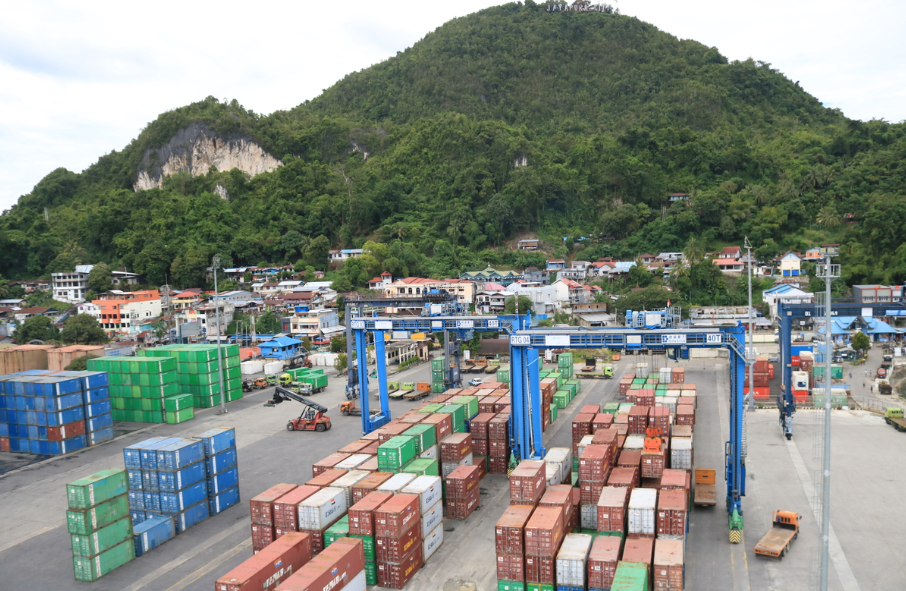
Manokwari International Port handles general cargo, inter-island passenger ferry services, and commodity export operations connecting the city to Sorong, Makassar, Surabaya, and other major Indonesian ports.
The port's capacity and operational efficiency determine the cost structure of consumer goods imports and commodity exports moving through Manokwari, making it a direct determinant of price levels and supply reliability across West Papua's Bird's Head region.
Together, Rendani Airport and the international port constitute the dual-gateway infrastructure on which Manokwari's function as a regional logistics hub depends.
Trans-Papua Bird's Head Corridor and Its Multimodal Logistics Role
The Bird's Head Trans-Papua road corridor connects Manokwari City to Sorong in the west and to interior regencies including Manokwari Selatan, Pegunungan Arfak, and Teluk Bintuni to the south and east. This corridor carries the primary overland freight volume serving West Papua's Bird's Head Peninsula, transporting agricultural commodities, construction materials, fuel, and consumer goods across a road network that traverses coastal lowlands, river crossings, and highland terrain.
Manokwari functions as the eastern anchor of the Sorong-Manokwari axis, which is the most economically active road segment in the province. Infrastructure investment along the Trans-Papua corridor in the Bird's Head region has been incorporated into national connectivity programs targeting Papua's development acceleration agenda.
Bridge construction, road surfacing, and gradient management projects along the most challenging mountain segments between the coast and interior zones are central to reducing the transport cost burden that limits commodity competitiveness and constrains access to government services for interior communities.
Manokwari's position as the corridor hub makes its port and road junction infrastructure the critical throughput point for the entire Bird's Head logistics system.
Greater West Papua Growth Projection and New Development Centers
West Papua Province's spatial planning framework identifies Manokwari City as the primary growth pole within a projected Greater West Papua urban region that encompasses adjacent regencies in a coordinated development zone. The projection targets expansion of government service infrastructure, university and vocational training capacity, healthcare facilities, and industrial processing zones as the structural foundations of metropolitan-scale growth.
Manokwari's role as the administrative, financial, and logistics center of the Bird's Head Peninsula positions it as the natural anchor for this regional growth framework.
New development centers projected within the Greater West Papua concept include industrial processing zones targeting cacao, palm oil, and fisheries value-added production, alongside logistics park development near the port and airport corridors.
The framework also incorporates ecotourism infrastructure investment connecting Manokwari City to the Arfak Mountains reserve and Doreri Bay marine corridor as complementary economic pillars alongside resource extraction.
Provincial planners position this diversified growth model as the pathway for Manokwari to capture a larger share of the value generated by West Papua's resource endowment while building urban service capacity sufficient to retain skilled workforce populations within the province.