
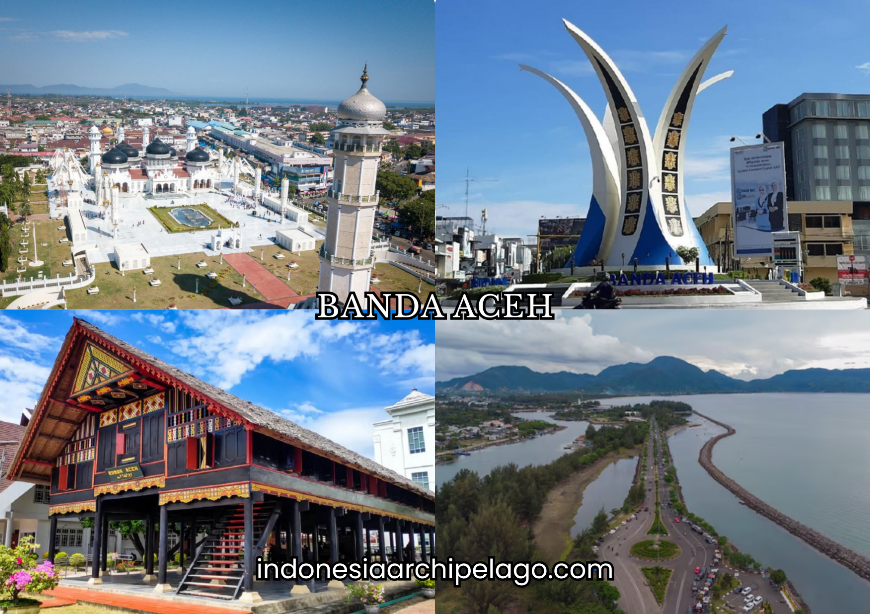
Banda Aceh City sits at the northwestern tip of Sumatra, occupying a position that has shaped its identity as both a religious center and a geopolitical landmark for centuries. The city carries the formal designation of provincial capital of Aceh Province, functioning simultaneously as an administrative hub, a commercial node, and one of the most culturally distinct urban spaces in the Indonesian archipelago. It serves as a major cultural, industrial, transportation, and educational center for the province, with a population approaching 360,000 people. Visitors arriving for the first time quickly understand that Banda Aceh City operates under a different set of social, legal, and architectural codes than the rest of Indonesia.
Nine Districts and the Urban Spatial Logic of the City
The city is structured into 9 sub-districts: Baiturrahman, Banda Raya, Jaya Baru, Kuta Alam, Kuta Raja, Lueng Bata, Meuraxa, Syiah Kuala, and Ulee Kareng. Each carries a distinct spatial function rooted in historical settlement patterns and post-tsunami urban reorganization. Baiturrahman occupies the historic city core and houses the grand mosque at its geographic and symbolic center.
Kuta Alam extends east along the coast and holds much of the commercial retail infrastructure, including the dense Peunayong trade district with its mix of ethnic Chinese shophouses and modern commerce.
Meuraxa borders the Indian Ocean to the northwest and was among the hardest-hit zones during the 2004 disaster, today serving as both a residential recovery zone and a memorial corridor. Syiah Kuala accommodates the university district and student-oriented activity near the river mouth, anchoring the city's academic output toward the southeastern edge.
Ulee Kareng operates as a residential and coffee-culture corridor in the southwestern zone, with dense concentrations of Acehnese coffee shops that run well past midnight.
Banda Raya and Lueng Bata function as mid-ring residential areas with growing middle-class settlement density. Jaya Baru and Kuta Raja anchor the western and northern urban fringe, supporting industrial and logistics functions adjacent to primary road corridors connecting to Aceh Besar.
The Veranda of Mecca and the Weight of That Name
The nickname "Serambi Mekkah" or Veranda of Mecca did not emerge from tourism marketing. It reflects the city's documented historical role as the primary gateway through which Islam entered and spread across the Nusantara.
Aceh was the first region in the archipelago to establish a formal Islamic sultanate, and for centuries Banda Aceh City functioned as the point of departure for pilgrims traveling to the Arabian Peninsula for Hajj. The title carries a theological weight that residents take seriously: it implies custodianship of Islamic values, not simply geographic proximity to the religion.
Acehnese culture is primarily shaped by its strategic location as a trade route, which historically introduced Middle Eastern influences layered atop the native Malay cultural base, visible in religion, language diversity, and traditional customs including clothing and ceremony.
That layering is inseparable from the city's identity as the veranda through which outside influence was filtered, absorbed, and then redistributed outward to the rest of the archipelago.
Baiturrahman Grand Mosque: Architecture Built to Outlast Catastrophe
Baiturrahman Grand Mosque stands at the center of Banda Aceh City as the single most legible symbol of the city's spiritual and historical continuity. The original structure was built in 1612 during the reign of Sultan Iskandar Muda, one of Aceh's most powerful and expansionist sultans, during a period marked by profound cultural and religious development across the sultanate.
The Mosque functioned not only as a place of worship but as a center for Islamic scholarship, drawing students and clerics from as far as Persia, Arabia, and the Malay Peninsula.
The structure was razed by Dutch colonial forces in January 1874 during the First Aceh War, then rebuilt beginning in 1879 and completed on 27 December 1881. Today the Baiturrahman Grand Mosque carries seven domes and eight minarets, including the tallest minaret in the city at 35 meters. When the 2004 Indian Ocean earthquake and tsunami struck on December 26, the mosque survived with only minor structural damage, including wall cracks and a slightly tilted minaret near the main gate.
Survivors climbed its domes and pressed against its walls while the surrounding city was swallowed by waves. It served as a temporary shelter for displaced persons and only reopened for formal prayers two weeks after the disaster.
The 2004 Tsunami: How the City Archived Its Own Trauma
The earthquake that triggered the 2004 Indian Ocean tsunami registered a magnitude of 9.1 to 9.3, making it one of the most powerful seismic events ever recorded. The resulting waves devastated coastal Banda Aceh City within minutes. Meuraxa sub-district bore the most concentrated destruction.
Aceh Tsunami Museum in the Baiturrahman district now serves as the primary institutional space for memorializing the disaster, housing documentary records, survivor testimonies, and disaster risk education materials designed for both local and international visitors.
The museum's architecture itself is a deliberate spatial statement: the building form references the movement of waves, and a darkened corridor at the entrance simulates the disorientation of the water's arrival.
Beyond the museum, the PLTD Apung, a floating power generator ship weighing 2,600 tons, was carried 3 kilometers inland by the tsunami and now rests permanently in the Punge Blang Cut neighborhood as an outdoor monument to the scale of the event.
These sites collectively form the core of what tourism operators classify as the tsunami historical route through Banda Aceh City.
Educational Tourism and the Academic Geography of the City
Banda Aceh City holds a disproportionately large concentration of universities for its population size. Universitas Syiah Kuala (USK), the largest public university in Aceh, operates within the Syiah Kuala sub-district and anchors a corridor of research institutions, libraries, and student housing that extends toward the eastern fringe of the city.
UIN Ar-Raniry, the state Islamic university, operates nearby and specializes in Islamic law, education, and social sciences curricula that directly mirror the province's governance priorities.
Educational tourism in this context means more than campus visits. The city's academic infrastructure intersects with its cultural landscape in ways that attract researchers, journalists, and policy observers studying the implementation of Islamic governance within a democratic state.
Short-course programs in Acehnese language, Islamic jurisprudence, and post-disaster urban planning have drawn international participants particularly from Muslim-majority countries in Southeast Asia and the Middle East.

Natural and Modern Tourism Beyond the Disaster Narrative
Banda Aceh City has worked deliberately to diversify its tourism offering beyond the tsunami memorial circuit. Pantai Ulee Lheue, located in the Meuraxa sub-district, provides direct access to the Indian Ocean and serves as the departure point for ferry connections to Sabang and Pulau Weh, the latter being one of Indonesia's most recognized dive sites with coral ecosystems that recovered substantially in the two decades following the tsunami.
Gunongan Historical Park in the Kuta Raja sub-district preserves the ruins of a pleasure garden built during the Aceh Sultanate era, with architectural forms that reflect the influence of Mughal garden design as interpreted through a local Acehnese aesthetic.
The park sits adjacent to Kandang XII, the burial ground of Aceh's royal family, giving the site a layered historical density that rewards visitors interested in pre-colonial Southeast Asian court culture. Modern commercial leisure infrastructure, including malls, waterfront promenades, and branded hotel properties, has concentrated along the Kuta Alam corridor.
Islamic Sharia as Legal Infrastructure, Not Symbolic Gesture
Aceh is the only province in Indonesia with the formal legal authority to implement Islamic Sharia law across all dimensions of daily life. This authority was codified through Law No. 44 of 1999 on Aceh's special status and expanded under the Law on Governing Aceh passed in 2006 following the Helsinki Peace Agreement.
The legal framework covers worship, family law, civil transactions, criminal conduct classified under jinayat, education, and religious propagation.
In Banda Aceh City, this translates into observable daily practice. Businesses close during Friday prayers. Dress codes for both residents and visitors are enforced in public spaces by the Wilayatul Hisbah, the provincial sharia police. Alcohol is banned across the city without exception.
Gambling and public displays of physical intimacy between unmarried individuals carry formal legal consequences under the Qanun framework. Visitors from outside the province are expected to comply with local norms, and signage in hotels and public buildings makes those expectations explicit.
The Acehnese Ethnic Identity and Its Linguistic Architecture
The Acehnese people constitute the dominant ethnic group in Banda Aceh City, with a cultural identity that draws on centuries of maritime trade, Islamic scholarship, and armed resistance to external authority. The Acehnese language belongs to the Malayo-Polynesian branch of the Austronesian family but carries significant loanword layers from Arabic and Sanskrit, reflecting the historical movement of traders and scholars through the port.
The language is not mutually intelligible with standard Indonesian and requires deliberate study by outsiders.
Within the Acehnese language itself, dialectal variation is geographically meaningful. The Banda dialect, spoken within the city and immediate surroundings, is the prestige variant and differs in pronunciation and vocabulary from the dialects of Pidie, North Aceh, and Aceh Besar.
A standard greeting in the Banda dialect, "Peu Haba?" meaning "how are you?" or literally "what news?", signals both linguistic and social positioning.
Travelers who use even basic Acehnese greetings find the social reception markedly different from those who default entirely to Indonesian.
Robusta, Arabica, and the Coffee Culture as Economic Driver
Aceh Province is one of Indonesia's most significant coffee-producing regions, and Banda Aceh City functions as both the commercial distribution center and the primary consumption market for that output. Gayo Arabica, grown in the Central Aceh highlands, commands premium pricing in international specialty coffee markets and holds a Geographical Indication certification.
Robusta varieties cultivated across lower-altitude zones in Aceh supply the domestic blended coffee market. Both varieties move through Banda Aceh City's logistics and retail infrastructure before reaching export channels.
The coffee shop in Banda Aceh City is not a lifestyle accessory. It is a social institution. Warung kopi operate across every sub-district from early morning until past midnight, functioning as informal meeting spaces for business negotiation, political discussion, and community gathering.
Ulee Kareng sub-district in particular has developed a reputation as the coffee corridor, with dozens of establishments competing on roasting method, grind profile, and brewing technique in ways that reflect both tradition and growing engagement with specialty coffee practice.
Gold, Silver Crafts, Songket, and the Creative Economy
Banda Aceh City hosts a concentrated cluster of artisan producers working in gold and silver, a tradition tied directly to the city's historical role as a sultanate center where court craftsmen produced regalia, ceremonial weapons, and personal adornment items for the ruling class and merchant elite.
Contemporary goldsmiths in the Peunayong district and around the central market area produce both traditional forms and commercially adapted jewelry for retail and custom order.
Songket weaving, which involves the integration of gold or silver metallic threads into a silk or cotton base fabric, represents the most technically demanding textile tradition in the region. Songket textiles are used primarily in wedding ceremonies and formal ritual occasions where the complexity and material value of the garment communicates social status.
The production of a single songket panel requires weeks of work on a traditional hand loom, and master weavers capable of executing the most intricate patterns command significant respect and income within the creative economy.
Batik with Acehnese motifs and embroidered garments using Sulam Tangan technique add further depth to the textile sector.
Mie Aceh and Ayam Tangkap: Culinary Identity on a Plate
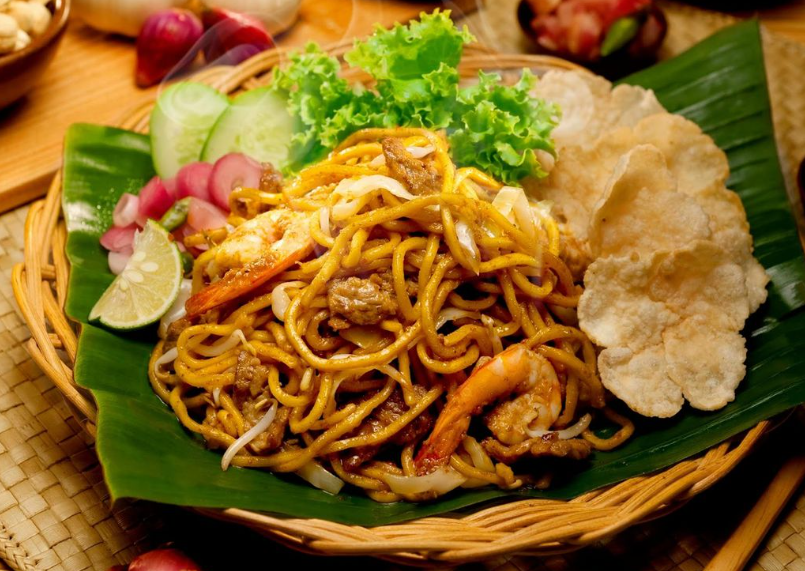
Mie Aceh is the city's most recognizable dish and the one against which all other representations of Acehnese cuisine are measured. The dish uses thick handmade yellow noodles cooked in a spiced curry base incorporating turmeric, cardamom, cumin, black pepper, and dried chilies, then served with a choice of beef, goat, shrimp, or crab.
Two preparation styles exist: the soupy version, Mie Aceh Kuah, which produces a rich broth, and the stir-fried version, Mie Goreng Aceh, which concentrates the spice profile into a drier, more intensely flavored result. Both versions are garnished with fried shallots, sliced cucumber, emping crackers, and lime wedges.
Ayam Tangkap, literally "caught chicken," is a preparation where diced local chicken is marinated with turmeric, shallots, ginger, garlic, and tamarind, then deep-fried alongside large quantities of curry leaves, pandan leaves, and green chilies until the aromatics become crispy enough to eat alongside the meat.
The result is a dish where the garnish becomes inseparable from the protein, delivering layered fragrance and texture in each serving. Street-level warungs and mid-range restaurants throughout Banda Aceh City serve Ayam Tangkap as a staple, and the dish has spread far beyond Aceh into Indonesian culinary culture as a recognized regional specialty.
Large Companies and the Commercial Infrastructure of the City
Banda Aceh City hosts the regional headquarters of major state-owned enterprise branches including Bank Aceh, the regional development bank that also operates as a full-service sharia bank, PT PLN for electricity distribution, PT Telkom Indonesia for telecommunications, and BPJS Ketenagakerjaan and BPJS Kesehatan for social insurance administration.
Private sector commercial presence is concentrated in retail, hospitality, food and beverage, building materials, and agricultural commodity trading. Several national retail chains including Suzuya Mall and hypermarket operators have established anchor positions in the Kuta Alam commercial corridor.
The construction and infrastructure sector has remained active since the post-tsunami reconstruction period, with ongoing urban development projects concentrated in the northern and western sub-districts. Property developers with regional footprints have positioned Banda Aceh City as a secondary market with above-average residential absorption rates relative to comparable cities in Sumatra.
Malahayati Port and the Logistics Architecture of Banda Aceh
Malahayati Port, located in Krueng Raya Bay approximately 35 kilometers northeast of Banda Aceh City, operates as the largest and primary commercial port in Aceh Province. The port handles dry bulk cargo, liquid bulk, containerized freight, and general cargo across dedicated berths managed by PT Pelindo Multi Terminal following a formal operational transfer in August 2023.
A new container terminal opened in 2013, and by 2018 the facility was processing more than 8,000 container units annually. As of early 2024, the Malahayati branch was serving over 75,000 tonnes of dry bulk cargo within the first two months of the year alone.
The port's geographic position provides direct access to the Malacca Strait, one of the world's most heavily trafficked maritime corridors, making it viable for both regional and international shipping routes. Customs and immigration services are administered through the Banda Aceh Customs Office, which handles clearance documentation for import and export cargo moving through the Malahayati facility.
The Ulee Lheue Port, located 6 kilometers from the city center, complements Malahayati by handling RoRo ferry services connecting Banda Aceh City to Sabang and the outer islands of the Aceh archipelago.
Export Commodities and the Trade Flows Out of Banda Aceh City
The primary export commodities moving through Banda Aceh City's logistics channels include Gayo Arabica coffee, palm oil derivatives, rubber, fishery products, and processed wood. Coffee occupies a strategically significant position because its Geographical Indication status allows it to command premium pricing in specialty markets across North America, Europe, Japan, and South Korea.
Exporters based in Banda Aceh City coordinate with plantation cooperatives in the Gayo highlands to consolidate volumes before moving product to Malahayati for containerized export or to Sultan Iskandar Muda International Airport for air freight consignments targeting premium buyers with strict freshness requirements.
Fishery exports include tuna and skipjack processed at facilities in the coastal sub-districts, with cold chain logistics managed through connections to the port. The handicraft and textile sector, including gold jewelry and songket, moves through a different channel, primarily direct sales to buyers via digital platforms and trade fair representation, with physical export volumes handled as air cargo consignments rather than sea freight due to product value and volume characteristics.
The Road Infrastructure Connecting Banda Aceh City to the Region
Banda Aceh City sits at the terminal point of the Trans-Sumatran Highway, the arterial road system that runs the length of Sumatra from Lampung in the south. This position makes the city both the endpoint of the longest overland freight route in western Indonesia and the origin point for goods moving outward by sea or air from the western coast of Sumatra.
Sultan Iskandar Muda International Airport, located in Blang Bintang approximately 14 kilometers from the city center, handles both domestic and international passenger routes as well as cargo operations, with connections to Kuala Lumpur providing the primary international gateway for business travelers and exporters requiring cross-border access.
The road network within the city was substantially reconstructed following the 2004 tsunami under international aid programs, resulting in road geometry and junction standards that are noticeably more organized than comparable Indonesian cities that were not subject to the same reconstruction effort.
That infrastructure legacy, combined with ongoing provincial investment in road maintenance, gives Banda Aceh City a logistical connectivity profile that supports both intra-city distribution and regional supply chain functions across the western Aceh corridor.