
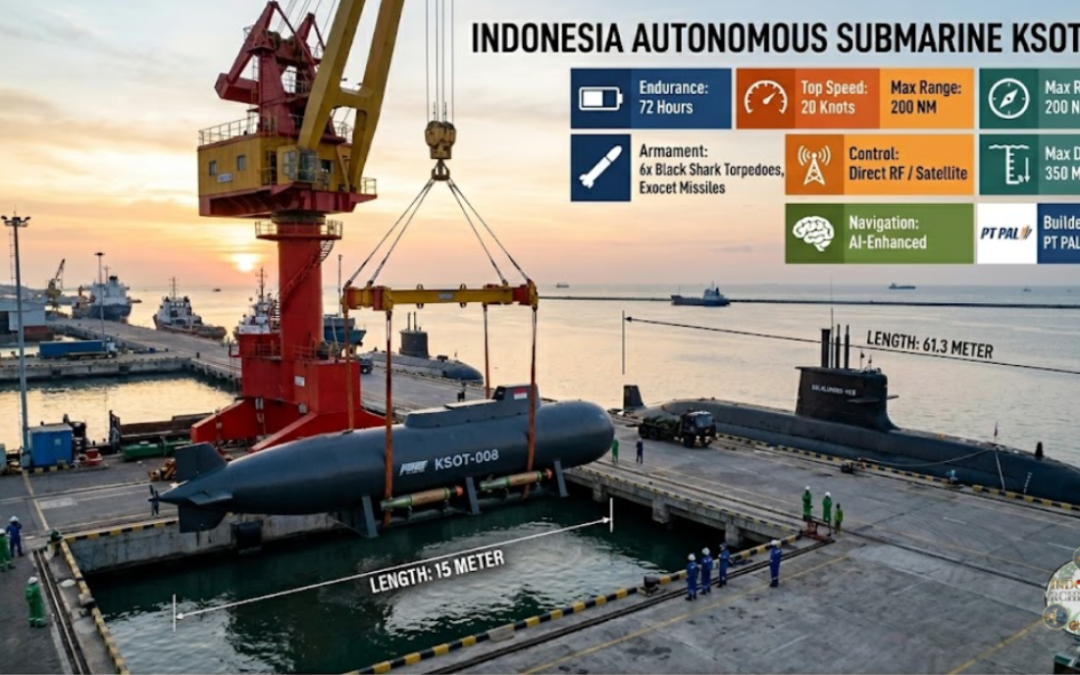
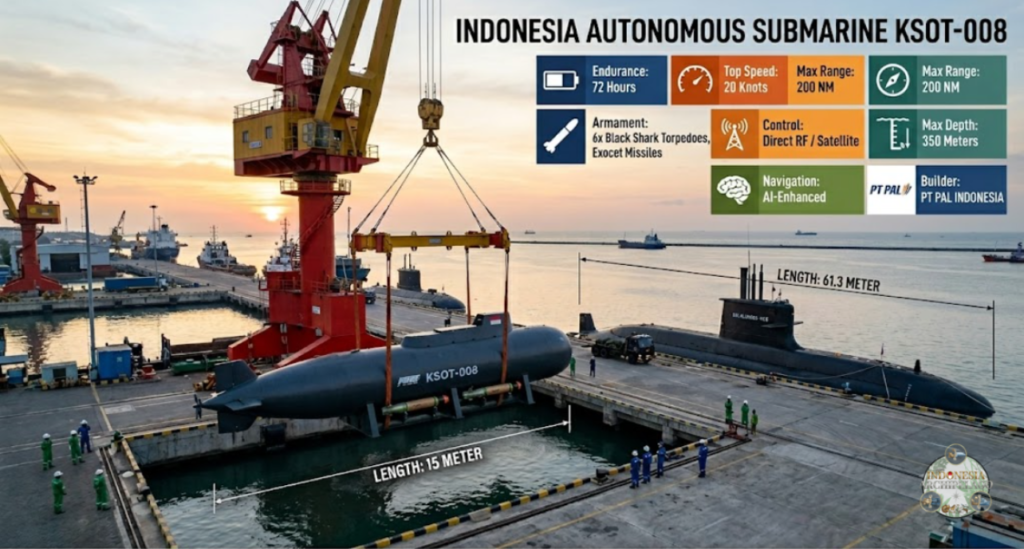
When PT PAL Indonesia unveiled the Submarine KSOT-008 to a global audience, it did more than display a piece of military hardware. Stretching 15 meters in length and riding atop a flatbed transport truck through a public demonstration, what greeted onlookers was not a prototype in the loosest sense of the word. Weighing 37.28 tons and designed from scratch by Indonesian engineers, it marked the arrival of a country that had quietly crossed a threshold most nations never reach. Indonesia had entered the world's most exclusive club in undersea defense technology.
A Defense Leap Decades in the Making
PT PAL Indonesia, the state-owned shipbuilder headquartered in Surabaya, has long been associated with conventional vessel production. From patrol boats to naval frigates, its manufacturing legacy runs deep in the country's maritime identity. Yet Submarine KSOT-008 represents something categorically different.
Built under a full mandate from the Ministry of Defense, the project did not emerge from incremental upgrades or foreign licensing agreements. It was conceived as an original design, executed by Indonesian engineers, and intended to carry a high level of domestic component integration under the country's TKDN framework.
Autonomous underwater vehicles have been developed by only a handful of nations capable of pairing submarine-grade depth performance with independent AI-driven navigation. Until recently, serious operational capability in this category was concentrated among the United States, Russia, and China.
Indonesia's successful torpedo firing tests and full operational trials with Submarine KSOT-008 now place it formally in that group, making it the fourth country in the world to achieve this milestone without foreign assembly or co-production arrangements.
What 15 Meters Can Carry Submarine KSOT-008
Size, in the context of unmanned submarines, is not a limitation. For KSOT-008, compactness is the point. With a hull length of 15 meters, a beam of 2.2 meters, and a draft of 1.85 meters, the vessel sits well below the detection profile of a conventional submarine. Its total displacement of 37.28 tons allows for rapid deployment from transport vehicles, coastal launch points, or naval support ships without requiring dedicated submarine infrastructure.
Mobility at sea is equally deliberate. Submarine KSOT-008 is rated for a maximum speed of 20 knots and an operational range of 203 nautical miles, giving commanders meaningful reach across Indonesia's vast maritime territory.
Continuous submerged endurance holds at 72 hours, meaning the vessel can execute a full three-day mission cycle without surfacing, resupply, or crew intervention.
For a maritime nation with over 17,000 islands spread across six million square kilometers of sea, those numbers carry real strategic weight.
Six Torpedoes and a Global Defense Partnership
Firepower aboard KSOT-008 is not symbolic. Integrated with Diehl Defense, the German defense manufacturer known for precision underwater weapons systems, the vessel carries six Black Shark torpedoes alongside Exocet missiles as its primary armament suite. Black Shark is a heavyweight torpedo system already used by several NATO-adjacent navies, with an active/passive homing capability suited to both surface and submarine targets.
Pairing it with Exocet, one of the most operationally proven anti-ship missiles in modern naval history, gives Submarine KSOT-008 a strike envelope that extends well beyond what its compact frame suggests.
Choosing Diehl Defense as an integration partner was not incidental. It signals that Indonesia's autonomous submarine program is being built toward interoperability with international defense standards, rather than closed domestic configurations.
For a country navigating complex regional security dynamics in the South China Sea and the broader Indo-Pacific, that kind of alignment carries diplomatic as well as military significance.
AI Navigation Beneath the Surface
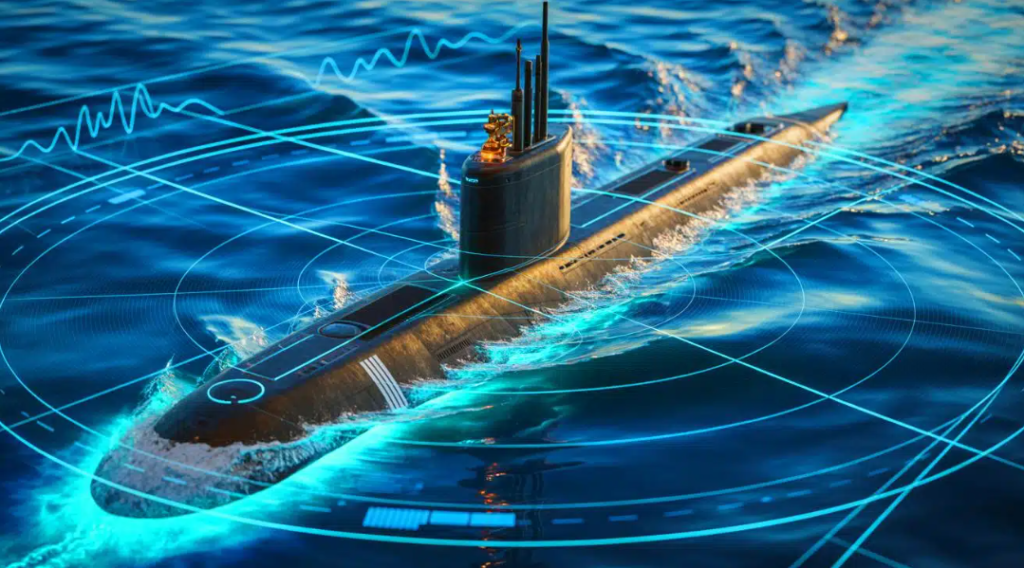
Guiding KSOT-008 through undersea operations without a crew requires more than pre-programmed waypoints. On-board navigation relies on artificial intelligence to process real-time environmental data, adapt to ocean current variations, and execute mission parameters autonomously.
Remote control is maintained via direct radio frequency and satellite communication links, giving operators surface-level command authority while the vessel remains submerged.
Independence from human crew is precisely what makes this class of platform strategically valuable. Manned submarines require life support systems, crew rotation logistics, and significantly higher operational costs per sortie.
Removing those variables allows Submarine KSOT-008 to be deployed in high-risk environments where exposing personnel would be tactically unacceptable, including contested waters, mine-threat zones, or areas under active aerial surveillance.
Three Variants, Three Strategic Purposes
Indonesia's Ministry of Defense has not designed KSOT-008 as a single-use platform. Announced plans call for three distinct operational variants, each engineered for a different tactical role within the broader naval doctrine.
First among them is a reconnaissance and maritime patrol configuration. Operating in stealth mode beneath the surface, this variant focuses on intelligence collection, persistent area monitoring, and early warning capability across Indonesia's extended exclusive economic zone.
Quiet, long-endurance patrols in sensitive corridors would provide real-time data without triggering the diplomatic visibility that surface vessels carry.
A second variant takes a more aggressive posture. Modeled on the kamikaze drone concept that reshaped land and aerial warfare doctrine in recent years, this underwater equivalent is designed to close on enemy surface vessels or submarines and deliver a terminal strike through detonation.
Expendable by design, it trades survivability for impact, functioning as a precision standoff weapon rather than a reusable platform.
Rounding out the program is a torpedo and missile launch variant, the configuration closest to what KSOT-008's current armament already suggests. Purpose-built for direct engagement in tactical combat scenarios.
This variant would operate as an autonomous strike asset capable of acting on targeting data relayed from surface command or aerial reconnaissance without requiring crew authorization at the point of engagement.
Competing in a Rapidly Evolving Global Category
Autonomous underwater vehicles have accelerated out of experimental phases across multiple defense programs globally. In 2023, the United States Navy's ORCA Extra Large Unmanned Undersea Vehicle completed key developmental milestones under a Boeing contract. Russia has publicly discussed the Poseidon nuclear-armed autonomous torpedo as part of its next-generation strategic deterrent.
China's development of underwater drone swarms has been tracked closely by regional defense analysts monitoring South China Sea operations.
Indonesia entering this space with a domestically produced platform positions it differently from countries that have purchased or licensed existing designs. Local production means sovereign control over modification timelines, export potential, and operational doctrine, none of which would exist under a foreign acquisition model.
For a nation that has historically relied on imported defense hardware from multiple competing suppliers, Submarine KSOT-008 represents a shift in posture toward strategic self-reliance.
PT PAL Indonesia and the TKDN Imperative
Domestic component content has become a benchmark across Indonesia's defense procurement policies in recent years. TKDN requirements push manufacturers to source from within the national industrial base, building supply chains that serve long-term industrial resilience rather than short-term unit cost optimization.
For KSOT-008, the Ministry of Defense's insistence on high TKDN compliance meant that much of the engineering, fabrication, and integration work remained inside the country, feeding into local technical workforce development.
PT PAL's role extends beyond production. As the program matures toward variant deployment, the shipyard will likely serve as the primary maintenance, upgrade, and possibly export certification hub for KSOT-008-class vessels.
That institutional role is significant. Few defense manufacturers in Southeast Asia hold the technical credibility to support autonomous submarine programs end-to-end, and PT PAL has now positioned itself among them.
Indonesia's Maritime Posture in the Indo-Pacific
Geography has always defined Indonesia's strategic reality. Sitting astride the Strait of Malacca, the Lombok Strait, and the Sunda Strait, three of the world's most critical maritime chokepoints, Indonesia's ability to monitor and assert control over its surrounding waters is inseparable from its broader national security posture.
KSOT-008 adds a dimension to that equation that surface patrols and conventional submarines cannot easily replicate.
Autonomous undersea systems create persistent presence without permanent deployment. A small fleet of Submarine KSOT-008 variants cycling through patrol, reconnaissance, and deterrence rotations could extend Indonesia's effective maritime domain awareness across areas where maintaining a full naval surface group would be logistically prohibitive.
In a region where territorial disputes, illegal fishing fleets, and great-power naval movements are constant variables, that kind of low-visibility persistent capability has compounding strategic value.
From Surabaya to a Global Audience
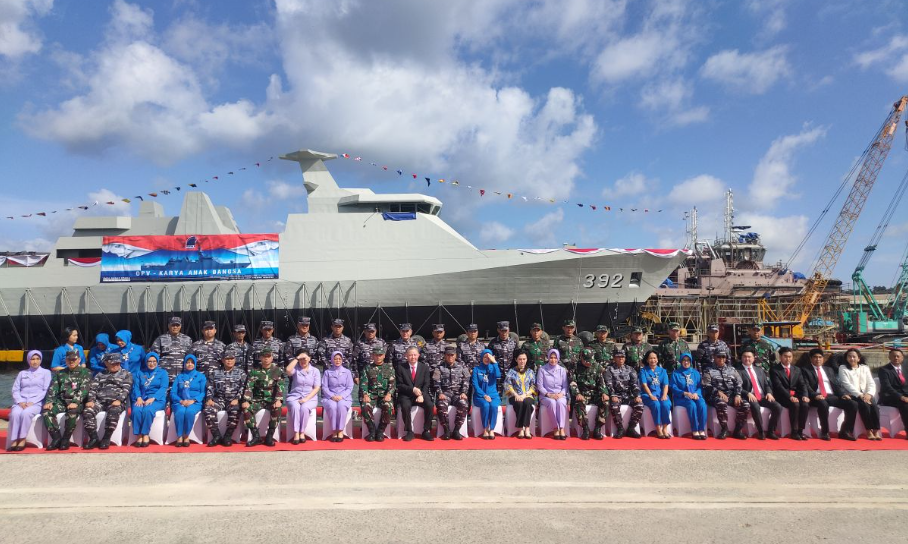
International defense observers watching Indonesia Archipelago's security developments have taken note. KSOT-008's public debut drew attention not only because of its specifications but because of what its origin says about Indonesia's industrial trajectory.
Designed by local engineers, built in Surabaya, armed with internationally certified weapons, and guided by artificial intelligence developed for operational naval conditions, it challenges the persistent assumption that advanced defense technology in Southeast Asia must originate elsewhere.
Regional defense establishments, from Singapore's naval command to Australia's strategic planning bodies, will be recalibrating their assessments of Indonesia's long-term military capability curve. KSOT-008 is not a concept vehicle or an aspiration.
It has completed live torpedo firing tests. It has demonstrated 72-hour autonomous submerged operation. Production variants are already in planning, and a clear three-tier strategic architecture has been publicly committed to by the Ministry of Defense.
What Comes Next for the KSOT Program
Entering the operational phase of any autonomous defense platform requires more than successful trials. Doctrine, crew training for remote operators, communication infrastructure, and integration with broader naval command systems all need to develop in parallel with hardware production. Indonesia will need to build the institutional architecture around Submarine KSOT-008 to convert its technological achievement into sustained operational capability.
Export potential will also become a question on the regional horizon. Several Southeast Asian navies have expressed interest in autonomous maritime platforms but lack the domestic production base to develop them independently.
If Indonesia can certify KSOT-008 for international sale, it would mark a reversal of the country's historical position in regional defense trade, shifting from importer to supplier in a high-value technical category.
None of that momentum, however, diminishes what has already been accomplished. PT PAL Indonesia and its engineering teams have built something that only three other countries in the world could previously claim.
For Indonesia's defense industrial ambitions, KSOT-008 is not the ceiling. It is the foundation.