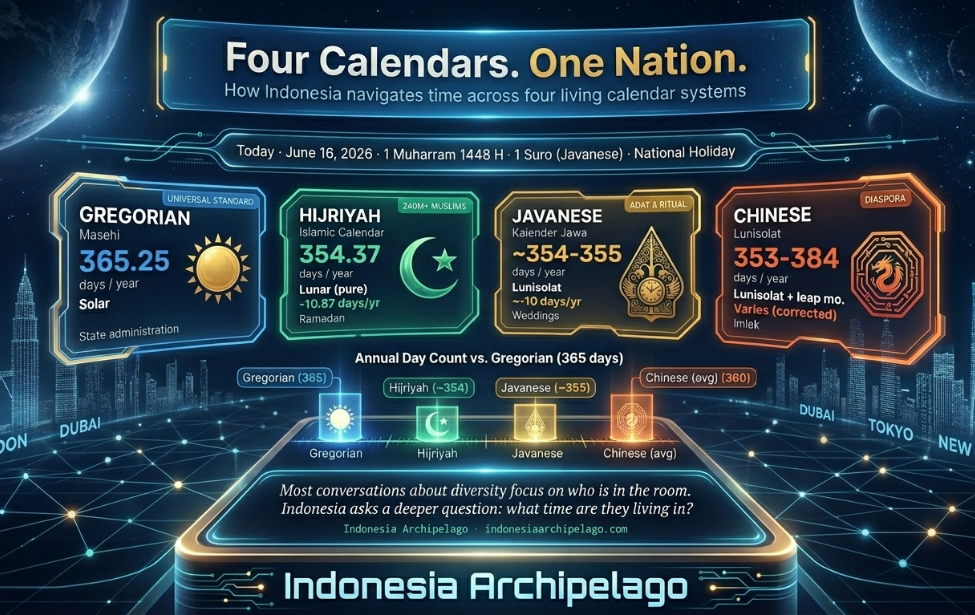
Every year, on a single date in June, Indonesia does something no governance framework in the world formally requires and yet few states have ever managed to sustain: it holds four entirely different systems of time in simultaneous public recognition. No one is asked to choose. No community is required to abandon its own count. The state simply acknowledges that time, like culture, is not singular.
On June 16, 2026, that convergence arrived again with unusual density.
The Gregorian calendar marked a Monday in the year 2026.
The Islamic Hijriyah registered 1 Muharram 1448 H, the first day of a new Islamic year.
The Javanese calendar entered 1 Suro, the opening of its most sacred month.
The Chinese lunisolar system continued through the fifth lunar month of the Year of the Horse, 4724.
Four counts, Four cosmologies, One national holiday.
When the Starting Point of a Year Is Not Agreed Upon
The divergence between these systems is not merely symbolic. It is mathematical, structural, and cumulative across centuries. The Gregorian calendar, adopted globally as the administrative standard, operates on a solar basis of 365.25 days per year.
It anchors itself to the Earth's revolution around the sun and has been corrected over centuries to minimize seasonal drift. For Indonesia, as for most of the world, it serves as the official framework for contracts, governance, taxation, and civil records.
The Hijriyah calendar is a purely lunar system, tracking the cycles of the moon without solar correction. A Hijri year spans approximately 354.37 days, which creates a structural gap of nearly 10.87 days relative to the Gregorian year.
The consequence of this gap accumulates with precision: in every 33 Gregorian years, 34 Islamic years complete their cycle.
Ramadan, Eid al-Fitr, and the Islamic New Year do not repeat on the same Gregorian date each year. They migrate forward, cycling through all seasons over the course of decades.
For 240 million Muslims in Indonesia, this calendar is not a historical artifact. It organizes the rhythm of daily and annual religious life.
The Javanese System and Its Five-Day Week
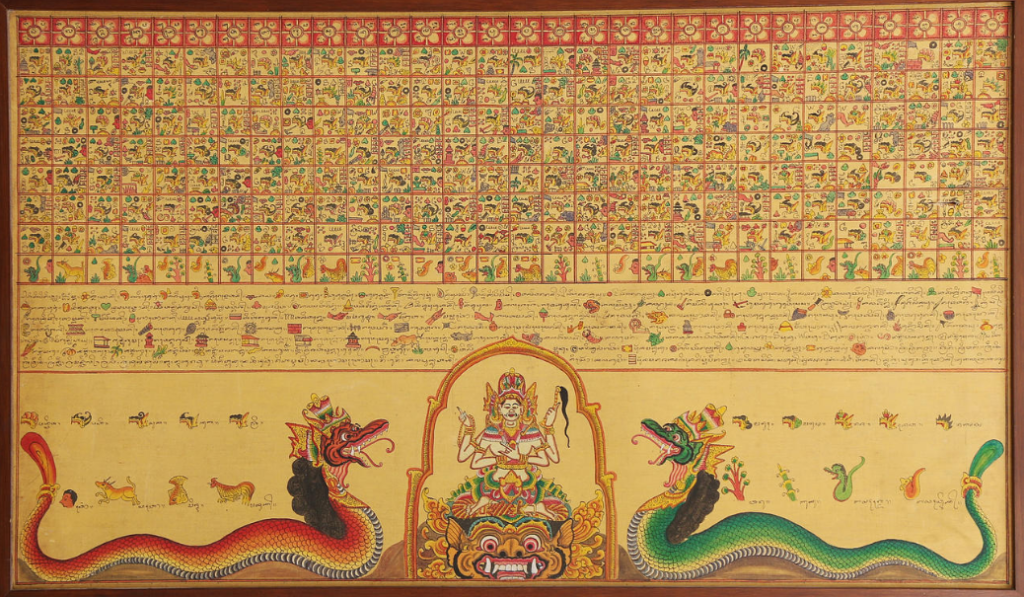
The Javanese calendar does not operate as a straightforward parallel to either the Gregorian or the Hijriyah. It is a lunisolar hybrid that drew on the Islamic lunar month structure when Islam arrived in Java during the fifteenth and sixteenth centuries, then overlaid it with an older five-day cycle inherited from earlier Hindu-Buddhist influence.
That five-day cycle, known as the pasaran, consists of five named days: Legi, Pahing, Pon, Wage, and Kliwon. When combined with the standard seven-day week, the pasaran generates 35 unique day combinations before the sequence repeats.
Each combination carries specific spiritual and practical significance that has been interpreted, refined, and transmitted across generations by Javanese communities.
The practical result is a calendar that produces guidance relevant to daily decision-making. Weddings, house moves, the planting of rice, the naming of a child, the launch of a business: all of these remain matters where the Javanese calendar is consulted not as superstition but as a structured knowledge system.
To describe it otherwise is to misread its function. A grandmother in Malang who consults the pasaran before setting a wedding date is not acting irrationally.
She is running a decision framework that has been stress-tested across centuries and continues to carry genuine social weight.
How Chinese Lunisolar Logic Corrects Itself
The fourth system in use across parts of Indonesian society is the Chinese lunisolar calendar, employed primarily within the Chinese-Indonesian diaspora for the observance of Imlek, Qingming, and other cultural and religious events. Where the Hijriyah accepts the full drift that comes with a purely lunar system, the Chinese lunisolar calendar corrects for it through a different mechanism.
Every two to three years, a leap month is inserted into the calendar to prevent excessive divergence from the solar year. The result is a calendar that varies significantly in length from year to year, ranging between 353 and 384 days, but which remains broadly anchored to seasonal cycles. Imlek, the Chinese New Year, does not drift indefinitely.
It consistently falls between late January and late February in Gregorian terms, a constraint maintained by the intercalation system across millennia.
This mechanism reflects a different philosophical approach to the problem of lunar drift: not acceptance of divergence, as in the Hijriyah, but periodic correction to preserve seasonal alignment while retaining lunar symbolism.
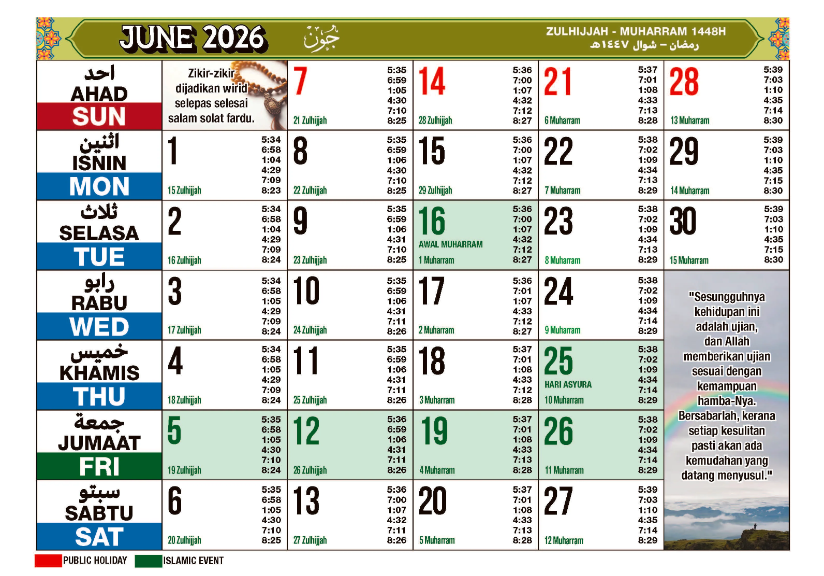
Four Systems Running Without Collision
What distinguishes Indonesia's relationship to these four calendars is not their existence. Multiple calendar systems coexist in many parts of the world, what distinguishes Indonesia is the institutional architecture that has been built around their coexistence.
The national public holiday framework formally accommodates events from all four systems. Islamic New Year, Chinese New Year, and Javanese cultural observances each carry official recognition at the state level.
No single calendar is treated as the only legitimate measure of time for purposes of social and cultural meaning. The Gregorian system handles administration. The others handle life.
This is a meaningful distinction. Many states that contain diverse religious and ethnic communities manage that diversity through formal tolerance, which tends to mean the dominant system is left intact while minority observances are accommodated at the margins.
Indonesia's calendar framework goes further. It treats the Hijriyah, the Javanese system, and the Chinese lunisolar calendar as parallel inputs into the public structure of time, not as exceptions made for minority communities.
What Temporal Pluralism Actually Means
The concept most relevant to understanding Indonesia's calendar coexistence is temporal pluralism: the recognition that different communities may organize, experience, and assign meaning to time through fundamentally different frameworks, and that a functioning society does not require these frameworks to be unified into one.
Global conversations about diversity have expanded significantly in recent decades. They address representation in leadership, inclusion in hiring, equity in access to services, and the removal of structural barriers faced by historically marginalized groups. These are real and necessary conversations.
What they less frequently address is the question of whose framework of meaning is treated as the default. Diversity initiatives that bring more people into a room while keeping the underlying operating assumptions of that room unchanged are working at the surface level.
Deeper pluralism asks whether the room itself, including its assumptions about time, value, and legitimacy, can accommodate difference at the structural level.
Indonesia's four-calendar system offers a tangible example of what structural accommodation looks like in practice. It does not ask the Javanese grandmother to stop consulting the pasaran. It does not ask the Muslim community to observe Eid on a fixed Gregorian date.
It does not ask the Chinese-Indonesian family to celebrate Imlek on January 1. It builds a national framework capable of holding all of these simultaneously.
The Role of Historical Layering
This accommodation was not designed in a single legislative act. It emerged through centuries of historical layering in which successive waves of cultural and religious influence were absorbed into Javanese and Indonesian society without requiring the complete replacement of what came before.
When Islam arrived in the archipelago, the Javanese calendar did not disappear. It incorporated the Islamic lunar month structure and continued. When the Dutch colonial administration imposed the Gregorian calendar as the official system for civil records, it did not displace the Hijriyah or the Javanese calendar from their social functions.
When the Chinese-Indonesian diaspora maintained its lunisolar traditions through periods of political suppression, the traditions survived and were eventually restored to formal recognition after 1998.
The result is a society in which multiple systems of temporal meaning have been stress-tested across centuries of contact, conflict, and accommodation. Their persistence is not accidental. It reflects the capacity of Indonesian communities to maintain cultural infrastructure under sustained external pressure.
The Structural Gap Between Policy Diversity and Lived Pluralism
The distinction between policy diversity and lived pluralism has practical implications beyond the calendrical. It points to a broader question about what diversity frameworks are actually designed to achieve.
Policy diversity tends to operate at the level of representation and access. It measures whether different groups are present in institutions and whether formal barriers to their participation have been removed.
These are important metrics. But they do not necessarily capture whether the institutions themselves are capable of accommodating genuinely different ways of organizing life, meaning, and time.
Lived pluralism, as Indonesia's calendar system illustrates, operates at the level of infrastructure. It is not about presence in the room. It is about whether the room is built in a way that does not require any group to leave part of itself at the door in order to enter.
Reading the Indonesian Example Without Romanticizing It
Acknowledging what Indonesia has achieved with its calendar system does not require romanticizing the broader social and political context. Indonesia faces significant challenges in other dimensions of pluralism, including religious freedom, ethnic minority rights, and the political use of identity. The calendar system is one domain of institutional accommodation, not a comprehensive portrait of social harmony.
What it does demonstrate is that structural temporal pluralism is achievable, that it does not require a single dominant framework to prevail, and that its maintenance over centuries is possible when communities retain the agency to preserve their own systems of meaning within a shared public framework.
The 1 Muharram convergence on June 16, 2026 is not a curiosity. It is evidence of a form of institutional design that the world has rarely managed to articulate clearly and almost never managed to build at national scale. Indonesia built it incrementally, through accumulation rather than design, across six centuries.
Why This Matters for Global Conversations on Inclusion
The global conversation on inclusion would benefit from engaging with examples that operate at the structural level rather than the representational one. Indonesia's four-calendar system is one such example. It does not tell the world how to replicate its conditions, which are historically specific and not transferable in their exact form. But it does illustrate a principle.
Diversity that reaches the infrastructure level, where the systems through which people organize time, meaning, and decision-making are held in parallel without hierarchy, is categorically different from diversity that operates only at the level of who is invited into a room that was built by and for someone else.
The Indonesian state has not solved pluralism. But it has been running four operating systems of time in production for six centuries. That is a data point worth taking seriously.