
Rwanda did something quietly remarkable over the past decade. While most governments treat school feeding as a welfare expenditure, Kigali reframed it entirely as industrial policy built around a lunch program. What emerged from that reframing is one of the more instructive food system stories on the African continent, and increasingly, one that policymakers across Southeast Asia are beginning to study with serious intent.
For Indonesia, which launched Makan Bergizi Gratis (MBG) in January 2025, Rwanda's model offers a benchmark that goes well beyond nutrition.
Indonesia's MBG program carries enormous ambition and an equally enormous budget. Whether it fulfills its economic potential or remains primarily a food distribution exercise depends heavily on design choices that Rwanda already tested, refined, and proved over more than a decade.
Understanding what Rwanda built, and how it built it, gives Indonesia a roadmap that no amount of domestic policy drafting can replicate on its own.
A Nation That Turned Lunch Into an Industry
Rwanda's central insight was deceptively simple. Millions of school children eat lunch every day. That daily demand, if routed deliberately through local food systems, becomes a permanent domestic market for farmers, cooperatives, food processors, and small enterprises. Government spending on meals does not disappear into consumption.
Instead, it circulates back into the rural economy as income, investment, and industrial growth. That insight became the foundation of a program that has since reshaped Rwanda's agricultural and food manufacturing landscape from the ground up.
School feeding stopped being a cost center and became a demand engine, one that private sector actors, cooperatives, and smallholder farmers could orient their production around with genuine confidence.
Home-Grown School Feeding and Its Core Architecture
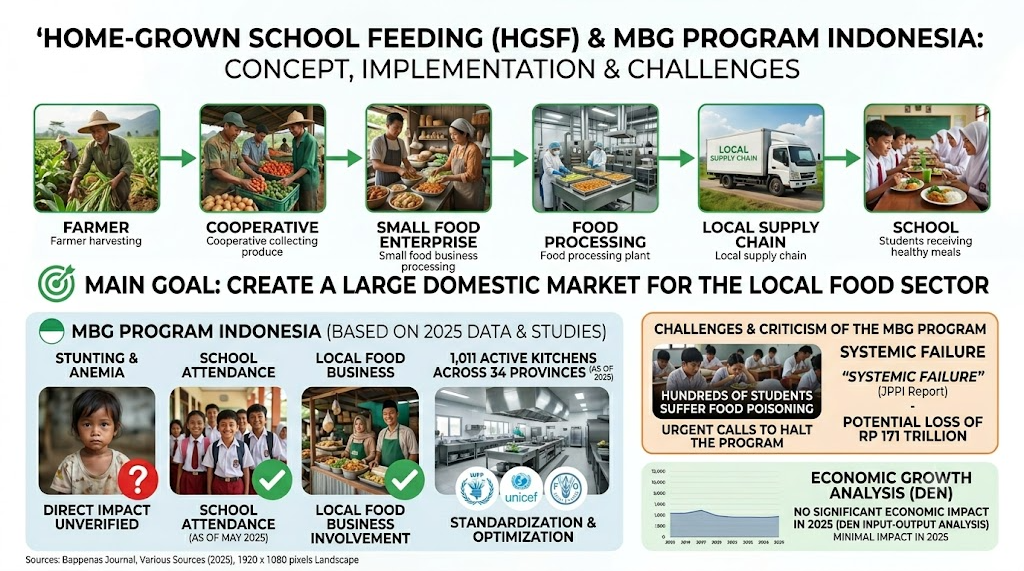
Rwanda's approach carries a formal name: Home-Grown School Feeding, known widely as HGSF. At its core, HGSF connects schools directly to local farmers, cooperatives, food processors, and small enterprises within surrounding districts. Schools are not passive recipients of food delivered by centralized vendors.
Schools become anchor buyers in a structured local supply chain, and every meal served creates a purchasing obligation that flows back into the agricultural and food manufacturing sectors of the community.
What makes HGSF structurally distinct from conventional feeding programs is its insistence on local economic integration as a first-order design objective, not an afterthought.
Procurement rules, supplier eligibility, and contract structures are all oriented toward keeping financial flows within the district economy. That design principle is what separates a school feeding program that feeds children from one that simultaneously builds an industry.
Schools Engineered as Permanent Domestic Markets
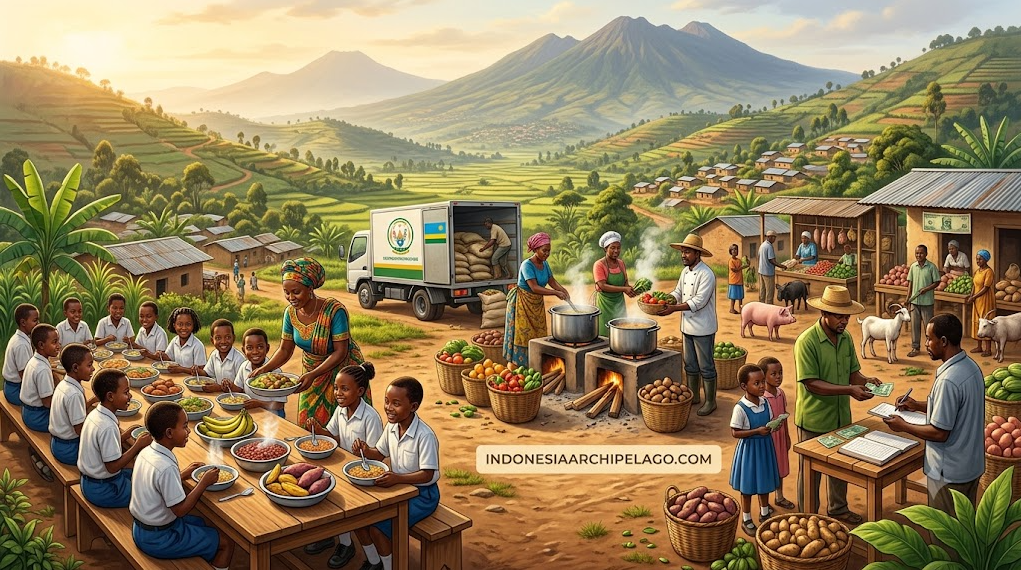
At the operational heart of Rwanda's model sits a deliberately engineered demand signal. With millions of students enrolled in public schools, daily food requirements are massive and entirely predictable. Government policy mandated that schools source ingredients locally, covering maize, beans, rice, milk, vegetables, cooking oil, tubers, and eggs.
That mandate transformed schools into stable, guaranteed customers for smallholder farmers who previously had no reliable buyer for their harvests.
Farmers gained something more valuable than a subsidy. They gained a contract. Predictable revenue from school procurement changed how farmers planned their seasons, how they accessed credit, and how they invested in land and equipment.
A guaranteed buyer at the end of the harvest cycle is a more powerful agricultural development tool than most subsidy programs ever manage to be.
What Guaranteed Demand Does to a Rural Economy
Predictable purchasing power produces specific structural changes in rural economies. When a farmer knows a school cooperative will buy maize at a confirmed price every week, planting decisions change. Credit becomes accessible because future income is demonstrable. Investment in storage infrastructure becomes justifiable because produce no longer needs to move immediately at distressed prices.
Across Rwanda's participating districts, farmer organizations began scaling up not because of direct subsidy, but because demand was real, recurring, and institutionally backed. Data from Solid'Africa, a Rwanda-based nutrition, and supply organization operating a farm-to-plate model sourcing from over 7,000 local farmers.
Showed income increases averaging around 61 percent among participating producers. That figure is not a projection. It is a measured outcome from a model that has been running long enough to generate reliable data.
The broader economic effect compounds over time. As farmer incomes rise, rural household spending increases, local markets deepen.
Service providers, transporters, and input suppliers all benefit from the increased economic activity that school feeding procurement sets in motion at the base of the chain.
Maize and Bean Processing Grew Around School Contracts
Before HGSF scaled across Rwanda, most smallholder output moved as raw commodity with minimal value addition. Farmers sold grain while intermediaries captured processing margins. School feeding contracts changed that calculation sharply. Schools required processed, standardized, distribution-ready products rather than raw sacks of grain.
That requirement gave rise to maize milling facilities, bean processing units, fortified porridge manufacturers, and packaged ingredient suppliers, all oriented around the volume and quality standards that school procurement demanded.
Grain storage infrastructure and district-level logistics networks followed organically from that same demand pressure. Processing became worthwhile because the buyer was guaranteed.
What Rwanda demonstrated is that institutional procurement standards, when applied consistently, pull entire supply chains upward. Farmers invested in quality because quality was rewarded, processors invested in capacity because contracts were renewable.
Logistics operators invested in routes because volumes were predictable. School feeding became the quality anchor for an entire regional food economy.
Fortification Became a Commercial Opportunity
Rwanda's nutrition agenda within school feeding opened a specific industrial lane. Because government policy pushed for micronutrient-rich meals, demand emerged for biofortified maize, iron-rich beans, and vitamin-enriched foods. Research institutions including the University of Rwanda partnered with food companies to develop pro-vitamin A maize varieties, high-iron legumes, and orange-fleshed sweet potato crops suited for school menus.
School feeding became the guaranteed off-take market that made investment in domestic food fortification commercially viable for private industry. Before that guaranteed demand existed, fortified food products had limited commercial prospects in rural Rwanda.
After it existed, those same products had a large, recurring, government-backed customer base that justified research, production, and distribution investment simultaneously.
One Cup of Milk Per Child Built Rwanda's Dairy Sector
Rwanda's "One Cup of Milk per Child" initiative deserves particular attention as a sector-building instrument. By committing to daily milk provision across national schools, government created a procurement volume large enough to justify significant investment in dairy infrastructure. Milk collection centers expanded into rural areas.
Pasteurization capacity grew to meet consistent volume requirements. Cold chain logistics reached districts that had no prior refrigeration infrastructure.
Dairy cooperatives consolidated smallholder output and gained the scale needed to fulfill school contracts reliably, turning subsistence cattle ownership into a structured commercial activity.
Farmers who previously sold small volumes of fresh milk locally, often at inconsistent prices, found themselves part of a formalized supply chain with stable income and access to cooperative services including veterinary support, breeding programs, and feed sourcing.
Rwanda's Dairy Path and a Postwar Japanese Parallel
Rwanda's dairy trajectory echoes a well-documented historical precedent. Japan used school milk programs after World War II as a deliberate mechanism to build a domestic dairy industry from near zero. Schools provided captive demand and industry responded with supply-side investment.
Rwanda replicated that same logic organically, with cooperatives rather than large corporations as primary beneficiaries.
That distribution of economic gains suited Rwanda's smallholder agricultural structure far better than any corporate-led model could have. When cooperatives capture the supply chain margin rather than large processors, income stays distributed across thousands of small producers rather than concentrating in a few corporate accounts.
School feeding policy, in this framing, becomes a tool for equitable industrial development rather than merely sector growth.
Cooperatives as the Structural Backbone of Procurement
Rwanda placed cooperatives at the center of HGSF procurement rather than routing contracts through centralized vendors or large distributors. Farmer cooperatives aggregated smallholder output, applied grading standards, handled basic processing, managed storage, and fulfilled school delivery contracts directly.
That intermediary role elevated cooperative membership from a social arrangement into an economic necessity. Smallholder farmers who once sold individually at suppressed margins found that cooperative membership unlocked access to institutional markets they could never reach alone.
Cooperatives gave small producers the organizational scale to meet school contract requirements for volume, consistency, and food safety standards that no individual farmer could satisfy independently. Membership became a practical economic decision rather than an ideological one.
Bargaining Power Shifted Toward Producers
When cooperatives hold school supply contracts, the bargaining structure of local food markets shifts in favor of producers. Individual farmers negotiating with private traders carry almost no leverage. Cooperatives negotiating on behalf of hundreds of members, with a confirmed institutional contract as collateral, carry considerable leverage.
Rwanda's HGSF effectively used school purchasing policy to redistribute economic power within rural food systems without direct producer subsidy.
That structural intervention outlasts any individual program cycle. Once cooperatives are formalized, capitalized, and operationally capable of fulfilling institutional contracts, they retain that capacity regardless of whether school feeding policy continues at the same scale.
Rwanda effectively used school feeding as a cooperative development program that built durable rural economic institutions.
Schools That Produce Their Own Food
Several Rwandan schools extended the model inward. GS Gasaka and similar institutions developed kitchen gardens, mushroom cultivation units, vegetable plots, and small poultry operations directly on school grounds.
These micro-production systems reduced external procurement costs, introduced students to agricultural practice, and fed surplus production back into community nutrition.
School grounds became low-scale food production sites, creating hyper-local food economies embedded within educational institutions themselves. Students gained practical agricultural and entrepreneurial skills alongside their academic education.
Teachers became facilitators of food production knowledge. Communities developed a closer relationship with the schools as productive economic nodes rather than purely instructional facilities.
Rwanda's Return on Every Dollar Invested
Rwanda's HGSF carries a fiscal argument that often goes underappreciated in policy discussions. When school food budgets flow to local farmers and cooperatives rather than centralized vendors or imported products, public spending recirculates within the domestic economy rather than leaking outward.
An independent economic study cited by Rwanda's Ministry of Education found that every one dollar invested in school feeding returns approximately 4.80 dollars in economic value across productivity, health, nutrition, and education outcomes combined.
That return ratio reframes school feeding entirely, shifting it from social expenditure to long-cycle economic investment. A government that views its school feeding budget as generating a 4.80x return has a fundamentally different relationship with that budget line than one that views it as a welfare cost.
Rwanda's fiscal framing of HGSF as investment rather than expenditure has sustained political commitment to the program through multiple budget cycles and government transitions.
Indonesia's MBG Program and What It Shares With Rwanda
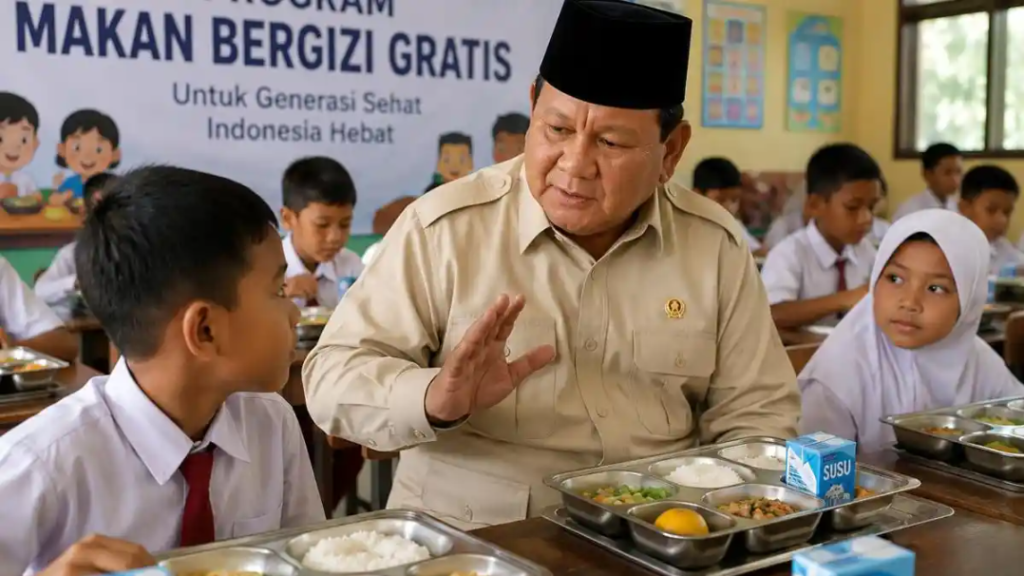
Indonesia launched Makan Bergizi Gratis, known as MBG, in January 2025 under President Prabowo Subianto. Designed to reach 82.9 million beneficiaries by year-end, MBG covers school children, pregnant women, and breastfeeding mothers across 34 provinces.
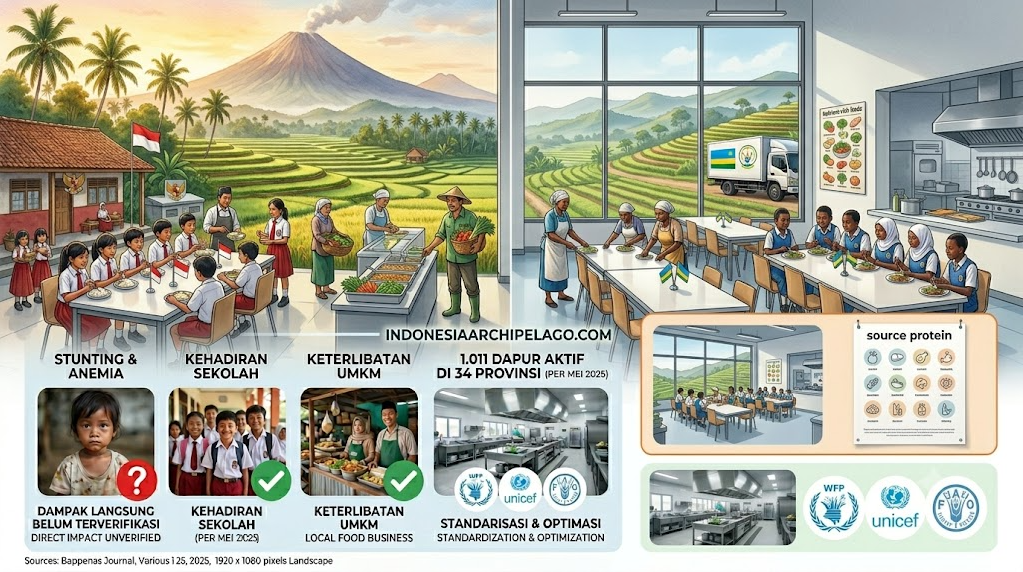
As of May 2025, over 1,011 community kitchens were operational, with WFP, UNICEF, and FAO providing direct technical support on menu optimization, supply chain standards, and food safety protocols.
UN Indonesia confirmed full institutional backing for MBG as a cornerstone of bilateral development cooperation. WFP is exploring AI-driven menu optimization that considers nutrition, sourcing, food availability, and pricing.
UNICEF is supporting national guideline development and training local kitchen teams on supply chain strengthening.
FAO is conducting analytical studies to map regional food consumption gaps at provincial and household levels across Indonesia's vast geographic spread.
Local Sourcing Architecture Already in Place
MBG's procurement design prioritizes farmers, fisherfolk, UMKM (micro, small, and medium enterprises), BUMDes (village-owned enterprises), and local cooperatives as primary suppliers. Academic research published in SOLUSI journal confirmed that this procurement architecture aligns structurally with HGSF principles, connecting nutritional intervention with local food system strengthening.
Early indicators show positive signs of UMKM engagement and improved school attendance across participating districts. Researchers at Bappenas have documented that MBG contract data at district level shows early correlation with improvements in farmer terms-of-trade indicators, though the dataset remains limited and the time horizon too short for definitive conclusions.
The structural foundation for an Indonesian version of Rwanda's multiplier effect exists on paper and in early practice.
Where MBG Currently Diverges From Rwanda's Matured Path
Rwanda's model matured over years of deliberate design iteration and institutional buildup. Indonesia's MBG is moving at enormous speed and unprecedented scale, and that pace has exposed implementation gaps that independent observers documented carefully.
CISDI and JPPI, two prominent Indonesian civil society organizations, flagged food safety failures after multiple student food poisoning incidents across provinces, describing the pattern as a systemic failure rather than isolated incidents.
Monitoring systems currently track input indicators such as meals served and kitchens established, rather than nutritional outcome indicators such as stunting reduction or anemia rates. That evaluation gap limits the program's capacity to adapt based on evidence.
Current monitoring tells administrators how much food moved through the system. It does not yet tell them whether children are healthier, better nourished, or more consistently present in school as a result.
An Economic Impact Question Still Without a Definitive Answer
Indonesia's Dewan Ekonomi Nasional (DEN), or National Economic Council, conducted an input-output analysis of MBG. Council member Arief Anshory Yusuf stated publicly that MBG would not produce a significant economic growth impact in 2025. That assessment reflects a genuine gap between MBG's structural potential and its current execution depth.
Rwanda's economic multiplier was not an automatic outcome of feeding children. It was engineered deliberately through cooperative-centered procurement, local processing mandates, and years of supply chain formalization. Indonesia has the policy architecture on paper.
Translating it into measurable rural income gains requires the same institutional groundwork Rwanda built over a decade, and that groundwork cannot be compressed into a single budget year regardless of how large the program's financial commitment is.
The Multiplier Chain Rwanda Built and Indonesia Can Replicate
Rwanda demonstrated a specific economic cascade that school feeding policy can generate when designed with intent. Government food budgets flow to schools - Schools purchase from cooperatives - Cooperatives pay farmers - Farmers reinvest in production - Processors expand capacity - Logistics networks grow - Village income rises.
Local consumption spending increases. Each link in that chain was built through deliberate policy design rather than market accident. Indonesia's MBG sits at the beginning of that same potential cascade. Budget allocation of Rp 171 trillion is confirmed. Procurement policy already points toward local sourcing priorities.
What remains is the institutional infrastructure covering cooperative formalization, processing capacity investment, cold chain development, and outcome-based monitoring, all of which converts a food distribution program into a functioning rural economic engine.
Indonesia's geographic diversity adds both complexity and opportunity to that replication effort. Rwanda is a small, landlocked, relatively homogenous agricultural economy. Indonesia spans 17,000 islands with radically different food cultures, crop systems, and logistical realities across 38 provinces.
Scaling Rwanda's model across that diversity requires provincial-level adaptation of procurement rules, cooperative support, and processing investment rather than a single national template applied uniformly.
A Benchmark That Reframes What School Feeding Can Become
Rwanda's school feeding story did not begin as economic policy. It began as a response to food insecurity and high school dropout rates in its poorest southern and western districts. Over time, consistent design choices that kept money circulating locally built something far larger than its original mandate. Food security and rural economic development proved not to be competing priorities within this model.
Properly structured, a national school feeding program becomes the mechanism through which smallholder agriculture, cooperative enterprise, food processing industry, and rural logistics develop simultaneously, with children's nutrition serving as both the end goal and the economic catalyst that sets everything in motion.
Indonesia has inherited the same structural opportunity at a scale Rwanda never approached. What Rwanda proved over a decade, Indonesia now has the budget, the institutional partners, and the policy mandate to replicate and accelerate.
MBG's success will ultimately be measured not only by how many meals it serves, but by how deeply those meals reshape the rural economies that produce them.